Key Points
- Prefab construction reduces waste and build time, offering precision and low environmental impact.
- Shared amenities and smart-home technology create a connected, self-reliant community.
- Team Haverkate’s expertise guides buyers to sustainable, high-investment prefab communities.
The Prefab Village: A New Model for Rural Uruguay
At the edge of Uruguay’s timeless countryside, not far from the stone-walled silence of Pueblo Garzón, an idea is quietly taking shape. It has nothing to do with high-rise glamour or oceanfront spectacle, and everything to do with rethinking how we dwell together. The core concept: a small, walkable hamlet of precision-built homes — each one factory-crafted, low-impact, and seamlessly connected to the land — designed around shared gardens, edible landscapes, and a pace of life that puts community before square footage.
This is not a retirement village or a gated resort community. It is a pocket neighborhood assembled from modular prefabricated shells, where the boundary between inside and out is dissolved by sliding glass walls, where solar storage and rainwater harvesting are as standard as kitchen cabinetry, and where smart-home systems manage energy, light, and climate with a few taps on a phone. For an international buyer already in love with Uruguay’s interior — with its vineyards, its lagunas, its star-lit silence — the proposition is a sober-luxury response to a very modern question: can a second home feel both deeply private and genuinely communal?
Table of Contents
Engineering Serenity: How Prefab Modules and Shared Amenities Redefine a Countryside Home
Factory-built construction, long dismissed in luxury circles as boxy and uniform, has entered a radically different phase. Today’s modular and panelized systems allow for architectural precision that site-built framing rarely matches — and they do it with a fraction of the environmental footprint. Because the structure is assembled under a controlled roof, material waste is squeezed down to almost nothing. One panelized housing manufacturer reports that an entire on-site assembly produces no more than a single garbage can of refuse, with metal scraps recycled and clean wood waste composted.
For a Uruguay countryside setting, this matters enormously. It means a building process that disturbs the soil, the tree line, and the rhythm of rural life far less than a conventional build. The structure arrives in flat-packed panels or volumetric boxes, lifted into place within days, not months. As featured in Architectural Digest, a 540-square-foot hexagonal pavilion was framed in two and a half days using 60 mass-timber panels — a sequence that would typically consume five days of on-site labor. The entire fitting, interior finishing, and connection to off-grid systems was completed in six weeks. Extrapolate that to a cluster of five or six dwellings arranged around a central garden, and the speed-to-quality ratio becomes genuinely disruptive.
The Material Palette of Restraint
The sober-luxury ethos finds its perfect material expression in the elements these systems lean on. As detailed by ArchiExpo, recycled steel frames contain around 70 percent reclaimed content and deliver precision and durability, albeit at a modestly higher upfront cost than wood. Reclaimed wood, denser and more stable than virgin timber, gets used for interior cabinetry and wall cladding — it resists warping and carries a quiet patina no new material can replicate.
Inside, the finishes follow an honest, tactile logic. Marine plywood walls, Marmoleum flooring, and engineered hickory floors set a warm, unpretentious tone. Thermally insulated aluminum-framed glass slides open entirely, blurring the line between a living room and the campo beyond. Fold-down terraces, borrowed from compact cabin design, extend the floorplate outward without adding built area — every module carries the potential to unfold itself into the landscape.
Energy Autonomy as Standard
The most forward-thinking prefab communities also invert the relationship between a home and the grid. Instead of simply drawing power, each unit becomes a net supplier. Airtight envelopes, advanced insulation, heat-recovery ventilation, and high-efficiency heat pumps drive demand down. Solar photovoltaic arrays coupled with battery storage, rainwater harvesting and filtration, and modular living roofs planted with native grasses push these dwellings beyond the typical energy code requirements — in some prototypes, performance exceeds them by 50 percent. A LEED Platinum-certified urban example integrated water-catchment, solar thermal panels, and a living roof with recycled gypsum boards inside, pointing to a future where a countryside retreat can sequester as much carbon as it emits.
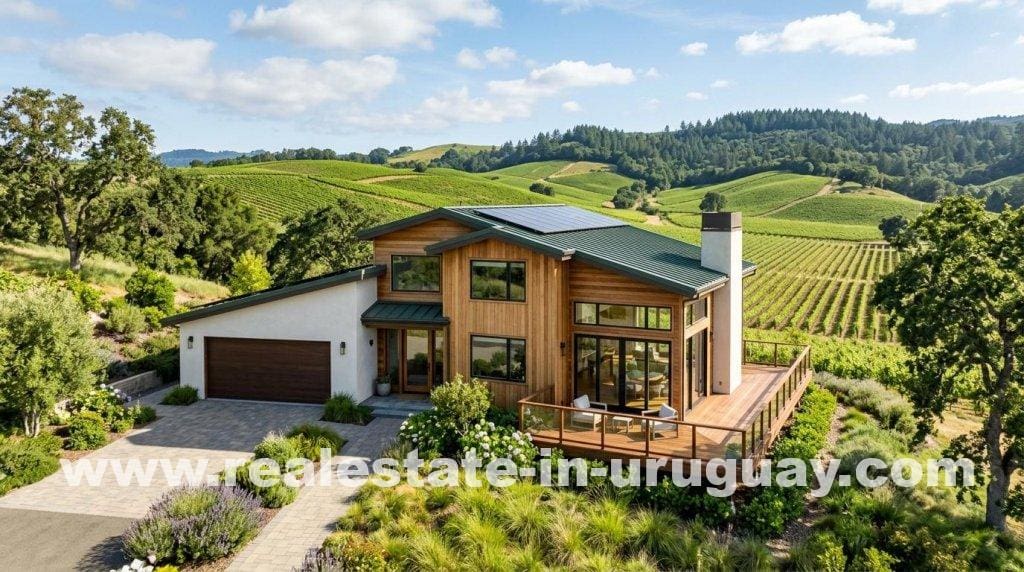
Smart-home technology is not an add-on but a quiet nervous system. Energy monitoring apps, automated shading, and adaptive climate controls let residents manage a property remotely — an attractive feature for international owners who might spend part of the year elsewhere. In a Pueblo Garzón context, the combination of self-reliance and digital oversight means less visible infrastructure, fewer power lines, and a landscape that remains unbroken by technology.
Team Haverkate’s Read on Uruguay’s Emerging Opportunity for Prefab Communities
Team Haverkate has spent years guiding international buyers through Uruguay’s interior, from vineyard estates to minimalist farmland retreats. The shift we now see is subtle but unmistakable: a growing number of sophisticated clients are asking not just for a piece of land, but for a considered, collective way of living on it. The prefab pocket neighborhood answers that demand with a supply chain logic that has rarely been applied outside urban infill or post-disaster rebuilding — until now.
Our analysis points to several advantages in the local market. First, quality control. Factory-built modules dramatically reduce the variability of on-site craftsmanship, a real concern in rural areas where skilled labor can be scarce. Second, financing and appraisal: units built to modular code, as opposed to manufactured housing standards, tend to carry higher valuation and better lending terms. That distinction matters deeply when structuring a property for long-term asset growth. Third, the regulatory landscape — while still evolving — is showing openings. Some jurisdictions are beginning to offer expedited permitting, density bonuses, and tax credits for projects that meet aggressive energy and carbon benchmarks. For a well-designed enclave of net-zero homes in a municipality eager to attract investment, the path could be smoother than many assume.
We also see a cultural fit. The Uruguayan campo has always prized the relationship between interior and exterior — the parrilla, the shaded veranda, the eucalyptus windbreak. Prefab modules that swing open to the elements align naturally with that heritage. Shared amenities like an edible garden, a communal swimming pond, or a workshop hall add a layer of texture that a single-family homestead alone cannot provide, without slipping into the forced sociability of a resort. Team Haverkate maintains excellent relationships with local sustainable builders experienced in prefabricated construction — buyers interested in this approach are encouraged to reach out directly for an introduction.
Beyond the House: Investing in a Connected, Sustainable Future in Uruguay
The structure one sleeps in is only part of the story. What emerges from the prefab village concept is an argument for lifestyle density done right — a handful of thoughtfully designed dwellings, each with its own private realm, brought together by design intelligence rather than by fences. It is a model that protects the wide-open character of Uruguay’s interior while introducing a contemporary layer of environmental performance and communal ease that was absent a generation ago.
International investors drawn to Pueblo Garzón’s art galleries, olive groves, and bodegas should examine their choice through this wider lens. A well-executed prefab community offers not merely a home, but an asset class that travels well: low-maintenance, energy-independent, thoroughly modern, and rooted in the kind of understated elegance that transcends cycles of taste. It is, in the end, a sober-luxury position in a country where land still feels elemental, and where doing less can mean building more meaning.
Before proceeding, international buyers need to understand the risks of dual agency in Uruguay’s real estate market. Dual agency occurs when the same broker represents both the seller and the buyer in a transaction, erasing the independence of advice the buyer expects. In a field where valuations can be opaque and land-use regulations patchwork, that arrangement creates a structural conflict: the agent’s commission depends on closing the sale at the highest possible price, not on protecting the buyer’s interest. Inflated property values and undisclosed liabilities become real threats. A buyer is best served by retaining separate representation — a firm with no financial stake on the seller’s side.
For those ready to explore a different way of inhabiting Uruguay’s countryside, Team Haverkate offers on-the-ground guidance that combines deep local market intelligence with an unwavering commitment to the buyer’s sole interest. This is exactly the kind of visionary, high-integrity real estate journey we were built to support.
Frequently Asked Questions
What is a prefab village in Uruguay?
A prefab village is a small, walkable hamlet of precision-built, factory-crafted homes designed around shared gardens and communal living. Located in Uruguay’s countryside near Pueblo Garzón, it offers low-impact, energy-autonomous homes with sliding glass walls, solar storage, and smart-home systems.
How does prefab construction differ from traditional building?
Prefab construction uses modular or panelized systems assembled under controlled factory conditions, reducing material waste to near zero. On-site assembly is faster—a 540-square-foot pavilion can be framed in 2.5 days and fully finished in six weeks—with less disturbance to the land compared to conventional builds.
What are the environmental benefits of these prefab homes?
These homes exceed typical energy code requirements by up to 50% using airtight envelopes, advanced insulation, heat-recovery ventilation, solar PV arrays, battery storage, rainwater harvesting, and living roofs. They aim to sequester as much carbon as they emit, and each unit can become a net energy supplier.
How does smart home technology work in a prefab village?
Smart-home systems manage energy, light, and climate via smartphone apps, allowing remote monitoring and control. Automated shading and adaptive climate controls enable international owners to manage their property from afar, reducing visible infrastructure and preserving the natural landscape.
What should international buyers know about dual agency in Uruguay?
Dual agency occurs when the same broker represents both buyer and seller, creating a conflict of interest. In Uruguay’s opaque market, this can lead to inflated values or undisclosed liabilities. Buyers should retain separate representation to protect their interests.
How does Team Haverkate assist with prefab community investments?
Team Haverkate offers on-the-ground guidance combining local market intelligence with a commitment to buyer-only representation. They connect international buyers with experienced sustainable builders and help navigate permitting, financing, and cultural fit for prefab communities in Uruguay’s interior.