Key Points
- Architectural Preservation: Discerning international buyers are acquiring classic Art Deco apartments in Ciudad Vieja and low-rise estates in Carrasco, modernizing interiors while preserving historic facades.
- European Comfort Standards: Renovation projects solve traditional thermal comfort issues by installing advanced hydronic radiant heating, double-glazed windows, and robust moisture barriers.
- FDI-Driven Growth: Backed by stable dollar-denominated assets, Europe accounts for over half of Uruguay’s inward FDI stock, with real estate acting as a primary driver.
Table of Contents
- The Vision: Montevideo’s Architectural Renaissance
- Capital Appreciation and Yields in Uruguay’s Capital
- Bridging Heritage and Modern European Comfort
- The European Connection: Foreign Direct Investment in Real Estate
- Team Haverkate Analysis: Navigating the Historic Restoration Market
- The Buyer’s Roadmap: Future Trajectory of Premium Micro-Communities
- Securing Your Investment: Why Dedicated Representation Matters
The Vision: Montevideo’s Architectural Renaissance
Imagine stepping into a sun-drenched 1920s Art Deco apartment in Ciudad Vieja, where towering four-meter ceilings and hand-carved double doors whisper stories of a golden age. You admire the ornate plasterwork and the sweeping views of the historic harbor, yet you also notice the gentle breeze of modern climate control keeping the interior perfectly comfortable. This is the new reality of Montevideo’s historic real estate market, where classic charm seamlessly merges with twenty-first-century luxury.
According to a 2026 real estate transaction report, the buying and selling of properties in Uruguay moved over $2.7 billion in 2025 alone, driven by a record number of new projects and a surge of European buyers seeking stable dollar-denominated assets. This capital influx is transforming the architectural landscape of the capital city. Discerning international buyers are no longer satisfied with generic modern high-rises when they can acquire a piece of history.
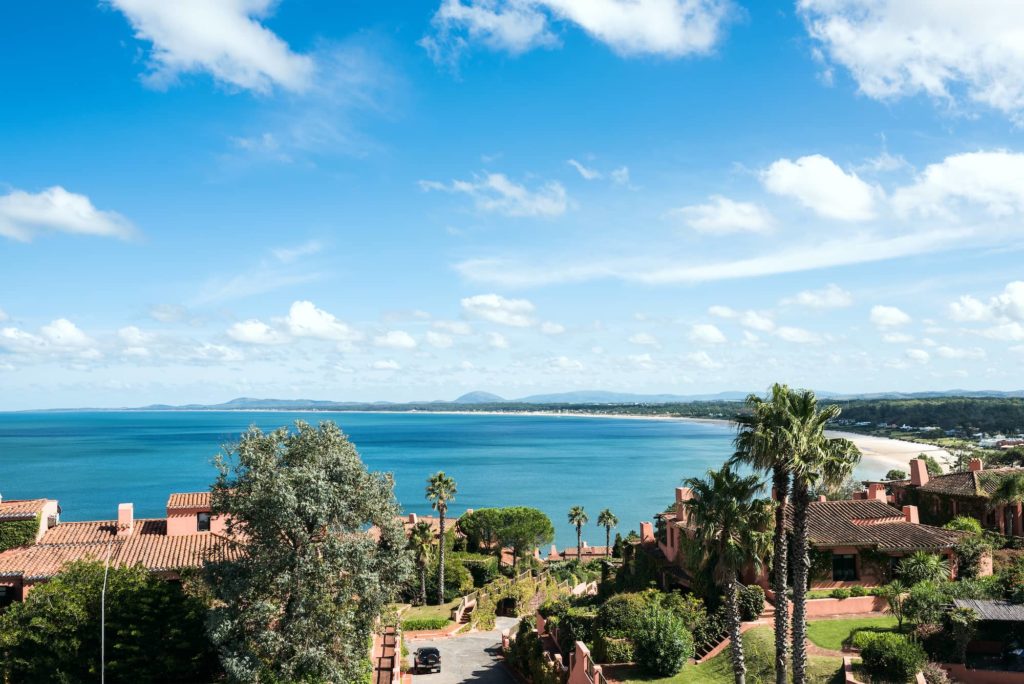
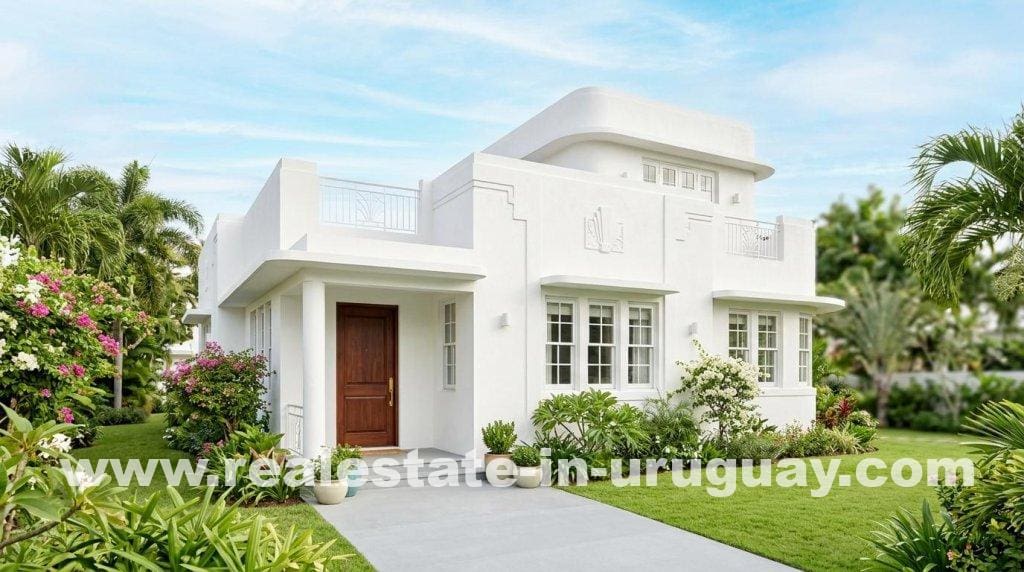
The architectural renaissance is particularly vibrant in two contrasting yet equally prestigious neighborhoods: Ciudad Vieja and Carrasco. While Ciudad Vieja offers dense, historic urban living with its spectacular Art Deco and colonial facades, Carrasco provides a serene coastal escape characterized by majestic, low-rise estates. Together, these areas represent the pinnacle of Montevideo’s premium restoration movement.
Capital Appreciation and Yields in Uruguay’s Capital
Investing in historic real estate requires more than just an appreciation for beauty; it demands rigorous financial validation. Montevideo’s property market continues to demonstrate remarkable resilience and steady growth, making it a safe haven for global capital. Buyers from the DACH region are particularly drawn to the combination of capital preservation and attractive rental returns.
Market Intelligence & Data
Nominal Price Growth
Uruguayan nominal home prices increased by 8.26% year-on-year in 2026, showcasing healthy capital appreciation and wealth preservation according to the Global Property Guide.
Average Rental Yield
The average gross rental yield for residential properties in Montevideo reached 6.47% in Q2 2026, offering robust income support for buy-to-let historic assets according to the Global Property Guide.
Average Days on Market
Residential properties in Montevideo maintain a stable average sales velocity of 85 days, reflecting balanced transaction dynamics without market freezes as reported by TheLatinvestor.
Sale-to-Asking Ratio
Uruguayan properties typically close at 93% to 95% of their initial listing price, providing international buyers with clear negotiation room as analyzed by TheLatinvestor.
The underlying metrics support this growing confidence in the local market. For instance, Global Property Guide’s analysis of Uruguay’s home price history highlights how nominal price growth has consistently outpaced regional volatility. This steady upward trajectory ensures that capital invested in premium restorations is well-protected over the long term.
Furthermore, the income potential for these modernized historic assets remains highly competitive. As detailed in Global Property Guide’s residential rental yields report for Uruguay, premium residential properties in Montevideo deliver robust gross yields. This makes buy-to-let historic restorations an exceptionally attractive vehicle for investors seeking stable cash flow alongside capital appreciation.
The balanced transaction dynamics in Montevideo also provide reassurance for international buyers. With a stable average of eighty-five days on the market, the real estate ecosystem avoids the sudden freezes seen in other global cities. This liquidity, combined with a predictable sale-to-asking ratio, allows for transparent and strategic negotiations.
Bridging Heritage and Modern European Comfort
A significant friction point has historically prevented international buyers from fully enjoying Montevideo’s heritage architecture. Traditional Uruguayan properties are notorious for high humidity, poor wall insulation, and outdated heating systems. These physical limitations often resulted in cold, damp winters that failed to meet the standards of modern luxury living.
Today’s sophisticated modernizers solve this challenge through an uncompromising process of structural renewal. Instead of superficial cosmetic updates, historic properties are stripped down directly to their original masonry bones. This allows engineers to address foundational issues and apply advanced technical retrofits from the inside out.
To ensure absolute thermal comfort, specialized restoration teams install premium European retrofits throughout the structure. These upgrades include high-performance double-glazed windows (DVH) to eliminate drafts and external noise. Additionally, robust moisture barriers and advanced hydronic radiant floor heating systems are integrated to create a perfectly balanced indoor climate year-round.
The integration of customized climate control systems ensures that these historic gems maintain the exact temperature and humidity levels desired by their occupants. By combining these invisible modern technologies with preserved high ceilings and original woodwork, developers create spaces that offer the best of both worlds. The result is a home that looks like a historic masterpiece but functions like a state-of-the-art modern residence.
The European Connection: Foreign Direct Investment in Real Estate
Uruguay’s appeal as an investment destination is deeply rooted in its political stability, strong legal framework, and welcoming attitude toward foreign capital. European investors have long recognized these advantages, establishing a dominant presence in the country’s financial landscape. This relationship has created a highly sophisticated ecosystem tailored to international standards.
According to the Lloyds Bank Trade Portal and UNCTAD, Europe as a whole accounts for a dominant 50.2% of Uruguay’s total inward Foreign Direct Investment (FDI) stock, with real estate activities representing a significant 11.2% of all FDI inflows. This substantial financial commitment underscores the trust that European buyers place in the Uruguayan legal and economic systems. It also ensures a continuous flow of capital to support high-end development projects.
The influx of European capital has also driven local developers to adopt more rigorous construction and management practices. By aligning with the expectations of DACH-region buyers, the local industry has elevated its overall quality standards. This alignment makes it easier for international investors to execute complex restoration projects with complete peace of mind.
Team Haverkate Analysis: Navigating the Historic Restoration Market
At Team Haverkate, we have observed a profound shift in how the smart money approaches the Montevideo property market. Sophisticated investors are increasingly bypassing generic new-build developments in favor of high-character historical restoration projects. They recognize that while anyone can build a modern tower, no one can replicate the soul and craftsmanship of a century-old palacete.
To capture these unique opportunities, we actively partner with premium global real estate networks to source undervalued renovation objects near landmark locations. Whether it is a hidden gem overlooking Plaza Zabala or a majestic low-rise estate along the Carrasco coastline, our focus is on finding properties with exceptional structural integrity and historic value. We then connect our clients with European-trained project managers who can execute restorations to the highest standards.
The financial efficiency of this strategy is highly compelling when executed correctly. By acquiring undervalued historic shells and managing the modernization process professionally, investors can achieve significant equity growth upon completion. Furthermore, these unique, high-character properties command premium rental rates and enjoy strong demand from high-net-worth tenants and future buyers alike.
The Buyer’s Roadmap: Future Trajectory of Premium Micro-Communities
The evolution of Montevideo’s historic real estate market is moving toward even greater sophistication and sustainability. The next logical step in this architectural renaissance is the creation of wellness-oriented, carbon-neutral historical micro-communities. This forward-looking approach combines heritage preservation with cutting-edge ecological engineering.
Strategic Trajectory
- Carbon-Neutral Micro-Communities: Transitioning towards wellness-oriented, carbon-neutral historical communities in Ciudad Vieja and Carrasco.
- Full-Scale ‘Palacete’ Restorations: Shifting developer focus from single-unit retrofits to restoring entire historic estates into high-end, self-sufficient residential ecosystems.
- Advanced Eco-Tech Integration: Embedding biophilic elements, integrated rooftop solar, and heat-recovery ventilation (HRV) into classic Art Deco architectures.
- Premium Expat-Centric Amenities: Incorporating curated luxury additions like private wine cellars and co-working lounges to attract permanent European expatriates.
As developers transition from individual apartment renovations to restoring entire historic estates, the opportunities for buyers are expanding. These comprehensive restorations allow for the integration of shared luxury amenities that were previously impossible to implement. From private wine cellars housed in historic vaults to state-of-the-art co-working lounges, these spaces cater perfectly to the lifestyle of permanent European expatriates.
The inclusion of advanced eco-tech systems ensures that these historic buildings are prepared for the future. By incorporating biophilic design principles, integrated rooftop solar power, and energy-efficient heat-recovery ventilation (HRV) systems, developers are proving that heritage preservation and modern sustainability can coexist beautifully. This holistic approach ensures long-term value and minimal environmental impact.
Securing Your Investment: Why Dedicated Representation Matters
Acquiring and restoring historic real estate in a foreign country is an incredibly rewarding journey, but it requires expert guidance to navigate successfully. The unique complexities of heritage regulations, structural engineering, and local administrative processes demand a partner who is fully committed to your interests. Without independent oversight, international buyers can easily fall into costly pitfalls.
We must issue a strong warning against the common industry practice of dual agency. In many transactions, a single broker attempts to represent both the buyer and the seller, creating an inherent conflict of interest that often leads to inflated valuations and compromised terms. This lack of independent representation can leave buyers vulnerable to undisclosed property defects and unfavorable contract structures.
Team Haverkate stands vehemently against dual agency. We operate exclusively as a dedicated Buyer’s Agent, meaning our sole fiduciary responsibility is to protect you, the investor, with independent legal, technical, and financial oversight. We ensure that every aspect of your purchase is thoroughly vetted and that your interests are prioritized at every stage of the transaction.
If you are ready to explore the extraordinary potential of Montevideo’s historic real estate, contact Team Haverkate today. Our expert advisory team is ready to assist you in English, German, French, or Dutch.
Frequently Asked Questions
Is Montevideo real estate a safe investment for European buyers?
Yes, Uruguay is highly regarded for its political stability and strong legal framework. European capital accounts for over 50% of the country’s total inward Foreign Direct Investment (FDI), and with nominal home prices growing at 8.26% annually, the market serves as a robust safe haven for capital preservation.
What kind of rental yields can I expect from historic properties in Montevideo?
According to 2026 data, the average gross rental yield for residential properties in Montevideo is 6.47%. High-character historic restorations in premium micro-communities often command higher yields due to strong demand from high-net-worth tenants and European expatriates.
How do modern restorations solve the humidity problems in old Uruguayan buildings?
Premium restorations address these issues by stripping structures to their masonry bones to install advanced moisture barriers, high-performance double-glazed windows (DVH), and hydronic radiant floor heating. These retrofits ensure European-standard thermal comfort year-round.
Why is the ‘Buyer’s Agent’ model recommended for international investors in Uruguay?
Independent representation is crucial to avoid the inherent conflicts of interest found in dual agency transactions. A dedicated Buyer’s Agent provides fiduciary oversight, ensuring thorough technical, legal, and financial vetting to protect the investor from undisclosed defects and inflated valuations.
Which neighborhoods are best for historic architectural investment?
Ciudad Vieja is the primary destination for Art Deco and colonial restorations, offering dense urban heritage. Carrasco is the preferred choice for those seeking majestic, low-rise coastal estates. Both areas are seeing significant capital influx from European investors focusing on premium restoration projects.
How liquid is the real estate market in Montevideo for premium assets?
The market demonstrates stable liquidity with an average of 85 days on the market for residential properties. Furthermore, the sale-to-asking ratio typically ranges between 93% and 95%, providing a transparent and predictable environment for strategic negotiations.