Key Points
- Sovereign Fiscal Evolution: Uruguay has transitioned from a regional tax haven to an elite global financial fortress, aligning its regulatory standards with premium European jurisdictions like Italy and the UK.
- Elevated Investment Thresholds: Under Law 20.446, the minimum real estate investment to qualify for the 11-year tax holiday has risen to USD 2,000,000, filtering out transient capital in favor of committed HNWIs.
- Uncompromising Construction Standards: High-end coastal and rural developments now integrate advanced European thermal insulation and hydronic heating systems to support seamless, year-round luxury living.
Table of Contents
- A New Fiscal Era: Analyzing the Sovereign Capital Shift
- The Architecture of Security: Building for Global Standards
- Fiscal Transparency and the New Tax Landscape
- Strategic Investment Insights from Team Haverkate
- Navigating the Sovereign Landscape: Your Strategic Blueprint
- The Sovereign Path Forward: Securing Your Legacy
Imagine the frustration of navigating a real estate landscape where shifting tax policies and opaque residency regulations continuously threaten your hard-earned capital preservation. Step into the shoes of a global investor seeking a bulletproof sanctuary for both wealth and family. For decades, the search for legal stability and high-quality living has led discerning individuals across the globe, yet few destinations have successfully matched the rigorous expectations of the modern elite.
According to the Uruguayan Real Estate Chamber (Cámara Inmobiliaria Uruguaya), the total volume of real estate transactions in Uruguay reached a record-breaking USD 2.7 billion in 2025, driven by a surge in high-net-worth European and regional buyers seeking stable capital preservation. This unprecedented demand marks a structural evolution. Uruguay has systematically shed its historic reputation as a regional tax haven, emerging instead as a highly sophisticated sovereign financial fortress.
By aligning its legal frameworks with elite European jurisdictions like Italy and the United Kingdom, the country has set a new benchmark for global wealth integration. For discerning families and institutional investors, this shift offers an unparalleled combination of legal certainty, physical security, and lifestyle excellence. Partnering with an expert advisory group like Team Haverkate ensures that you navigate this transition with absolute precision and local intelligence.
A New Fiscal Era: Analyzing the Sovereign Capital Shift
Market Intelligence & Data
New Tax Residency Threshold
Effective January 1, 2026, under Law 20.446, the minimum real estate investment required to qualify for the 11-year tax holiday was elevated from approximately USD 590,000 to USD 2,000,000, as reported by the Uruguayan tax authority (DGI) and tax advisory firm NTL International.
Flat Tax on Foreign Capital
Uruguayan individual tax residents who do not hold a valid tax holiday are now subject to a flat 12% Personal Income Tax (IRPF) on foreign-sourced capital yields and property transfers, according to the newly approved National Budget Law (2025-2029) evaluated by KPMG.
Year-on-Year Transaction Rise
Property transaction volumes nationwide in the first seven months of 2025 rose by 1.3% to 27,533 units, demonstrating high market liquidity and stable momentum, according to the National Institute of Statistics (INE).
First-Half Real Estate Sales
Real estate transactions across Uruguay reached over USD 1.17 billion in the first half of 2025 alone, reflecting strong capital inflows into the property market, as calculated from Property Transfer Tax (ITP) collection data published by El Observador.
The regulatory landscape has undergone a profound transformation. Under Law 20.446, effective January 1, 2026, the country has permanently closed the door on superficial, low-threshold tax residencies. The minimum real estate investment required to qualify for the highly coveted 11-year tax holiday has been elevated to approximately USD 2,000,000, representing a significant shift in fiscal policy.
This decisive policy change filters out transient speculative capital in favor of committed, high-net-worth individuals who contribute to the local economy. Sophisticated investors from Germany, Switzerland, and Austria are not deterred by these higher entry barriers. On the contrary, they actively seek the regulatory compliance and legal predictability that these rigorous standards represent.
To fully understand the underlying market dynamics, the Uruguay market report by the Global Property Guide provides critical data on long-term capital appreciation and transaction stability. This transition has fueled stable, organic growth across the country’s premium real estate sectors. For those considering buying property in Uruguay, the current environment offers a highly liquid, dollarized asset class that acts as a robust hedge against global inflation.
The Architecture of Security: Building for Global Standards
Historically, international buyers encountered a persistent friction when exploring the local market. The rustic, bohemian charm of coastal estates often came at the cost of modern thermal comfort. Traditional summer residences lacked the insulation, double glazing, and heating systems required for year-round living, making them less suitable for colder months.
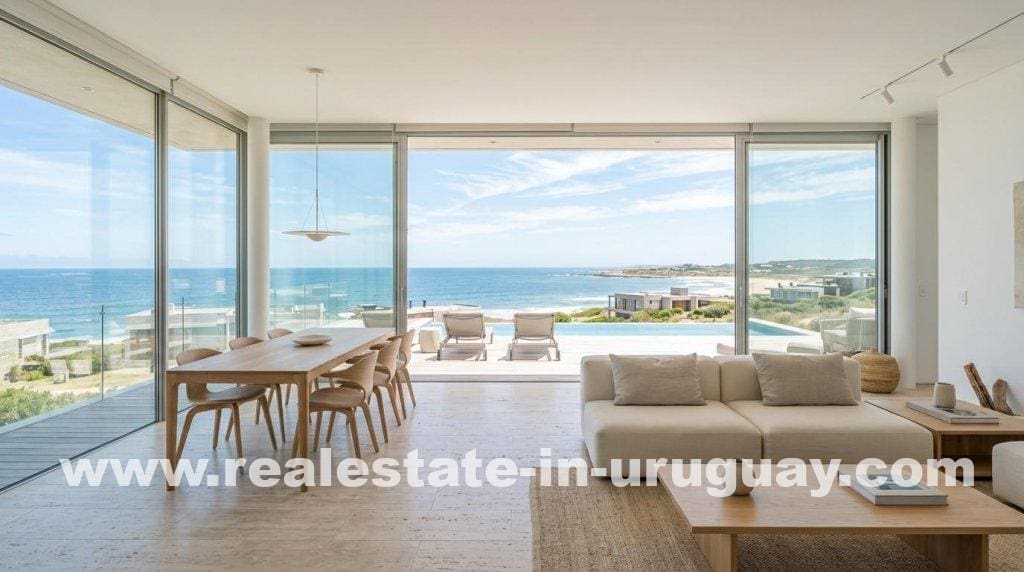
Today, the premium development sector has entirely resolved this disconnect by adopting uncompromising European building standards. Modern estates now feature hydronic underfloor heating, advanced thermal envelope insulation, and fully integrated smart home automation. These properties are built to perform seamlessly during the mild southern winters, ensuring absolute comfort and energy efficiency.
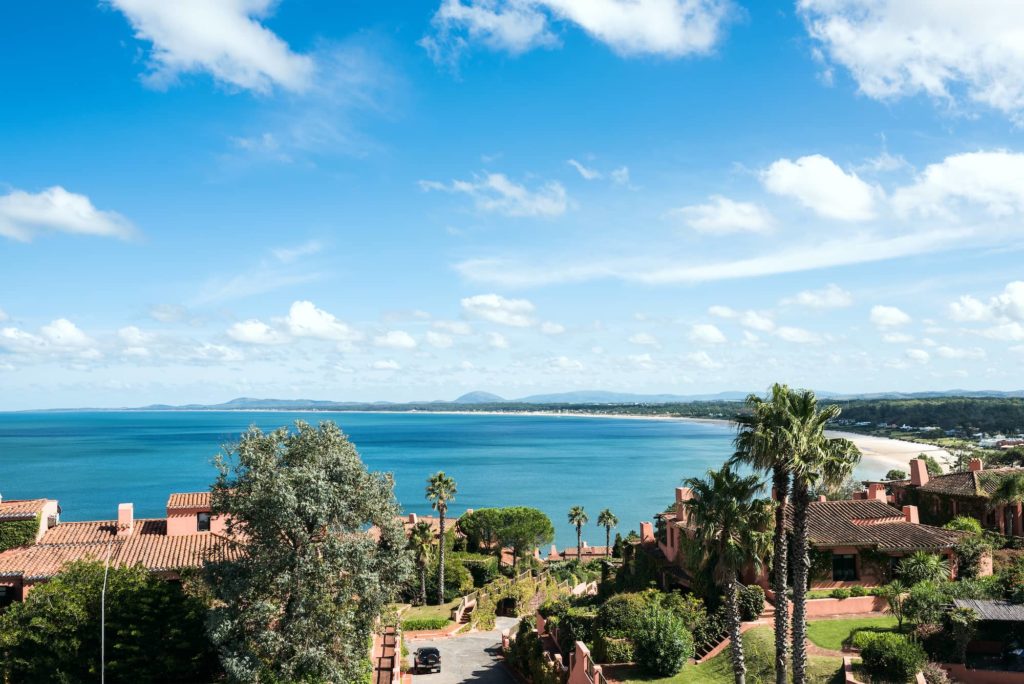
This architectural evolution is particularly evident in elite coastal enclaves like Punta del Este and José Ignacio. Investors are increasingly acquiring expansive countryside properties and historic farms to establish fully self-sustaining private estates. These high-end rural properties combine agricultural productivity with luxury residential infrastructure, offering a unique blend of privacy and utility.
Fiscal Transparency and the New Tax Landscape
Under Decree No. 95/026 issued by the Uruguayan Executive Branch in May 2026, the government introduced rigorous regulations for the 12% Personal Income Tax on foreign capital, forcing a new era of fiscal transparency that mirrors European standards and appeals directly to compliance-focused DACH investors. This decree underscores the nation’s commitment to international compliance standards, removing any lingering associations with opaque offshore structures.
By implementing a clear, flat 12% tax on foreign-sourced capital yields for those outside the tax holiday, the state provides a transparent and predictable fiscal framework. This level of transparency is exactly what institutional funds and family offices require to justify large-scale capital allocations. The alignment with global reporting standards ensures that your international assets remain fully compliant and secure.
As a result, the demand for premium real estate has shifted from speculative holiday homes to permanent, multi-generational family compounds. These estates are designed to serve as both secure physical sanctuaries and highly efficient financial vehicles. The integration of advanced legal frameworks with world-class infrastructure makes the country a standout choice for global wealth preservation.
Strategic Investment Insights from Team Haverkate
At Team Haverkate, we analyze these macroeconomic shifts to provide our clients with a distinct competitive advantage. The transition of coastal regions into year-round communities is driving a sustained demand for premium urban infrastructure. Cities like Montevideo are rapidly evolving into highly connected hubs that blend lifestyle appeal with corporate utility.
This urban transformation is supported by massive foreign direct investment in technology and infrastructure. For example, Google’s official $850 million infrastructure investment announcement highlights the country’s growing prominence as a regional technology capital. This influx of global tech talent and corporate infrastructure is creating a highly resilient rental and resale market for premium properties.
Discerning buyers are no longer just looking for seasonal beach houses; they are investing in permanent assets that offer long-term capital preservation. We specialize in identifying off-market opportunities that align with these macroeconomic trends, ensuring our clients acquire properties with strong appreciation potential and exceptional living standards. Our expertise allows us to guide you through every phase of this sophisticated market.
Navigating the Sovereign Landscape: Your Strategic Blueprint
Strategic Trajectory
- Geopolitical Risk Hedging: Integrate premium lifestyle assets with advanced geopolitical hedging for complete capital and family security.
- Ecological & Tech Integration: Align property portfolios with self-sustaining luxury requirements, prioritizing carbon neutrality and advanced tech autonomy.
- Elite Urban Development: Leverage Montevideo and Punta del Este’s expansion into ’15-minute cities’ anchored by global tech entities like Google.
- Autonomous Infrastructure: Focus acquisitions on ultra-luxury Fincas featuring independent solar microgrids, advanced water filtration, and satellite systems.
- Remote Sovereignty: Empower international CEOs to govern global enterprises seamlessly from highly secure, tranquil coastal sanctuaries.
Successfully executing an investment of this scale requires a sophisticated, highly coordinated approach. The local bureaucracy, particularly regarding construction permits and social security contributions, can be highly complex for foreign buyers. Engaging elite, boutique project management firms is essential to navigate these regulatory requirements without exposing yourself to unexpected liabilities.
Every step of the acquisition process must be managed with rigorous legal and financial oversight. By focusing on properties that offer ecological autonomy and advanced technological integration, investors can secure a truly future-proof asset. These self-sustaining estates represent the pinnacle of modern luxury and security, providing complete independence from public grids.
Furthermore, the integration of high-speed satellite connectivity and renewable energy systems allows global executives to manage their international enterprises seamlessly from their coastal sanctuaries. This unique combination of remote operational capability and physical security is unmatched in the region. It positions the country as the premier choice for forward-thinking leaders.
The Sovereign Path Forward: Securing Your Legacy
Uruguay’s emergence as an elite financial fortress offers a rare window of opportunity for global investors. However, navigating this highly sophisticated market requires absolute transparency and uncompromised representation. A classic pitfall in the local market is the widespread industry standard of dual agency, where a single broker attempts to represent both the buyer and the seller.
This practice inevitably creates a severe conflict of interest, often resulting in inflated valuations and compromised terms for the buyer. We believe that your capital and your family’s future deserve absolute protection. For this reason, Team Haverkate operates strictly as a dedicated buyer’s agent, offering exclusive fiduciary representation and independent oversight throughout your acquisition journey.
We invite you to experience the security and elegance of this remarkable sovereign haven. To begin exploring exclusive, off-market opportunities, contact Team Haverkate today. Our expert advisory team is ready to assist you in English, German, French, or Dutch.
Frequently Asked Questions
What is the minimum investment required for Uruguay’s tax holiday in 2026?
Effective January 1, 2026, under Law 20.446, the minimum real estate investment to qualify for the 11-year tax holiday has been increased to approximately USD 2,000,000. This regulatory change aims to attract high-net-worth investors committed to long-term capital preservation in a stable sovereign environment.
How does the new 12% flat tax on foreign capital affect international residents?
Uruguayan individual tax residents who do not possess a valid tax holiday are now subject to a flat 12% Personal Income Tax (IRPF) on foreign-sourced capital yields and property transfers. This transparent fiscal framework aligns Uruguay with elite European jurisdictions and provides long-term predictability for global investors.
Are Uruguayan properties equipped for year-round living by European standards?
Modern premium developments in Uruguay have moved beyond seasonal holiday homes to meet rigorous European standards. High-end estates now feature advanced thermal insulation, double glazing, and hydronic underfloor heating, ensuring absolute comfort and energy efficiency during the mild southern winters.
What role does tech infrastructure play in the Uruguayan real estate market?
Significant foreign direct investment, such as Google’s $850 million infrastructure project, has positioned Uruguay as a regional technology hub. This corporate growth drives demand for premium urban and coastal real estate, ensuring high market liquidity and a resilient rental market for sophisticated property owners.
Can I operate a global enterprise from a coastal estate in Uruguay?
Yes. The integration of high-speed satellite connectivity, independent solar microgrids, and advanced water filtration systems in luxury Fincas allows international CEOs and entrepreneurs to manage global operations seamlessly while enjoying the security and privacy of Uruguay’s coastal sanctuaries.
Why is a dedicated buyer’s agent necessary for property acquisition in Uruguay?
To avoid the inherent conflict of interest in dual agency—where one broker represents both the buyer and seller—it is critical to engage an exclusive buyer’s agent. Team Haverkate provides dedicated fiduciary representation, ensuring independent oversight and protecting the buyer from inflated valuations and opaque local practices.