Key Points
- Foundational updates (electrical, plumbing, insulation) prevent deferred-maintenance buyer discounts.
- Targeted kitchen, entry, and appliance upgrades yield higher resale recovery than full renovations.
- Lifestyle rooms, layered lighting, and staging make a Montevideo unit easier to value and sell.
Table of Contents
The Renovation Ledger That Rewrites Montevideo’s Resale Math
In Montevideo’s most liquid apartment markets, price growth is no longer driven by square meters alone. A disciplined renovation strategy that prioritizes visible entry signals, efficient kitchens, and flexible interior space is determining which units sell first and which sellers quietly discount. The eight categories — foundational updates, soapstone countertops, appliance upgrades, front-door paint, lifestyle rooms, layered lighting, resort-like landscaping, and professional styling — form a transferable investment framework, not a decorating checklist.
The opportunity is not in spending more; it is in spending where a future buyer can instantly understand the value. That distinction matters in Uruguay, where sober luxury rewards restraint, material honesty, and durable decisions over short-lived aesthetic noise. This is not a case study of one building; it is a prescriptive lens for Montevideo’s urban residential stock.
Eight Levers for a Sober-Luxury Montevideo Asset
For an investment audience, the most valuable renovations are rarely the most photogenic. They are the ones that remove friction from a buyer’s underwriting: they signal low deferred maintenance, clear spatial purpose, and an aesthetic that does not need to be undone.
Foundations Before Finishes
Foundational updates set the ceiling for every other improvement. In Montevideo, that means electrical panels, plumbing, waterproofing, and thermal performance before stone or paint. An energy audit, air sealing, insulation improvements, and duct repairs may have modest line-item costs, but they protect the asset against the deferred-maintenance deductions that sophisticated buyers apply immediately.
In U.S. benchmarks, an energy audit averages about $437, air sealing can run $350 to $1,000, and insulation upgrades $1,200 to $3,000, according to Bankrate. Backup power generators have climbed into top-ROI territory in storm-prone regions, though their relevance in Montevideo is largely limited to premium new builds and resilience-minded owners.
Kitchen and Entry Signals
Soapstone countertops are materially different from standard polished stone: dense, non-porous, heat-tolerant, and naturally matte. They appeal to a buyer who values aging well over showroom shine. When paired with integrated, energy-efficient appliances and a restrained faucet package, the kitchen reads as more considered than a budget breakdown would suggest.
Minor kitchen remodels have shown recovery rates between roughly 96% and 113%, depending on scope and methodology. One U.S. data set places a minor remodel at $28,458 in cost and $32,141 in resale value. The stronger return tends to come from coherent, moderate upgrades rather than full slab-and-appliance showcases.
Entry signals are often cheaper and faster. A steel door replacement recovered 216% in one benchmark, making the front entry one of the few exterior improvements to outperform most interior renovations. Front-door paint is a separate low-cost lever: exterior painting may return only about 50% in some estimates, but the psychological weight of a crisp threshold is disproportionate on a well-maintained building.
Appliance upgrades work best when they reduce noise, energy draw, and visual clutter. A smart thermostat, for example, costs roughly $113 to $264 and saves about 8% on energy bills annually. That is not a headline selling point, but it is an easy due-diligence pass for buyers who still remember inefficient building systems.
Light, Flexibility, and Final Presentation
Lifestyle rooms — a genuine home office, a flexible second sitting area, a defined dressing space — are the clearest expression of remote-era demand. In Montevideo, where many pre-2000 apartments have formal living-and-dining layouts, showing a room with a specific use can separate a unit from comparable inventory.
Remote workplace services were projected to reach $58.5 billion by 2027, and 23% of the U.S. workforce worked from home in late 2025. That demand does not translate directly to Montevideo, but it shapes what international buyers expect from an investment apartment: a space that can function as both home and office without a renovation.
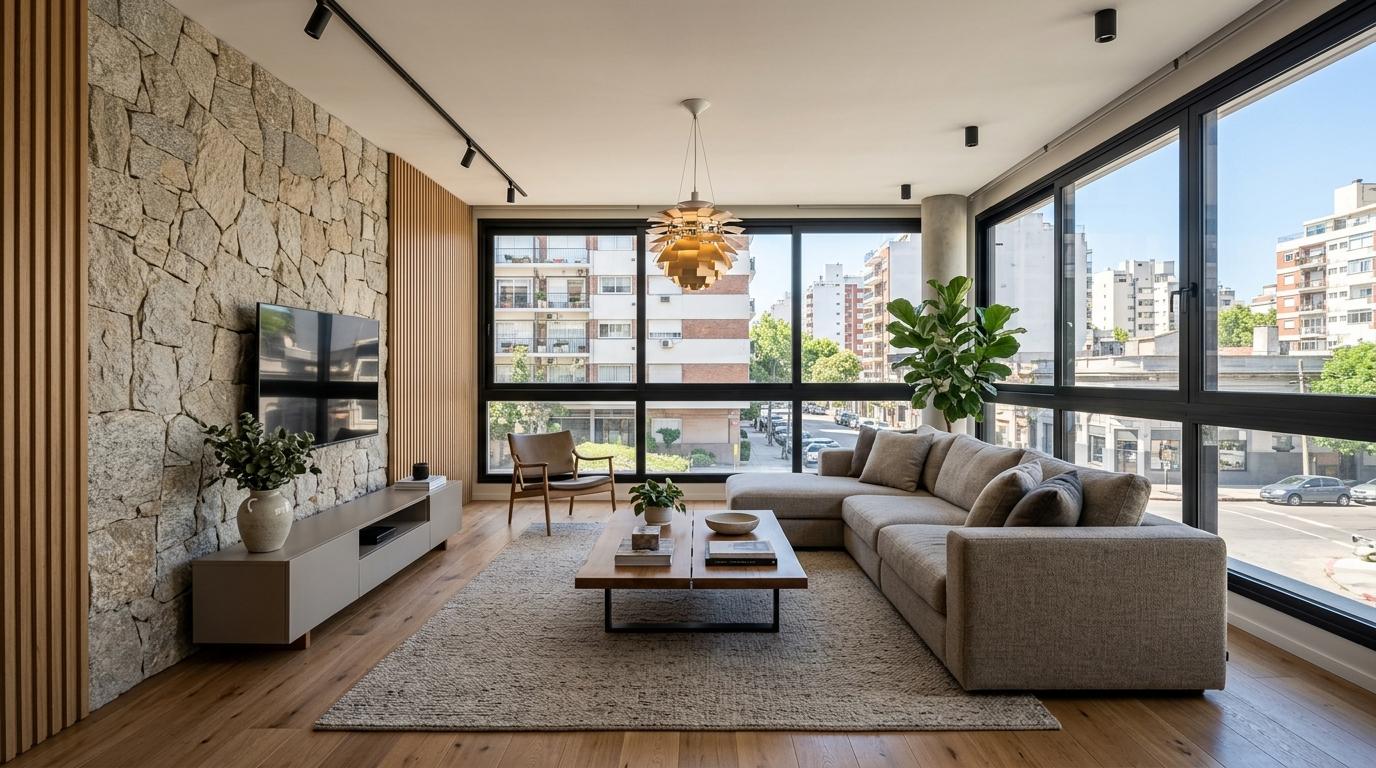
Layered lighting is the quietest of the eight categories and one of the most effective at creating an apartment that feels composed rather than decorated. Recessed, task, and accent layers allow a buyer to read spaces as intentional. This matters especially in buildings with deep floor plates or limited natural light.
Resort-like landscaping, reimagined for urban Montevideo, becomes courtyard planting, terrace greenery, or a curated rooftop. Landscaping and curb appeal work can cost roughly $781 to more than $2,100 and has been reported to return up to 200% in some U.S. contexts. The urban equivalent is smaller in scale but similar in logic: greenery at the entrance or terrace expands the perceived sellable area.
Professional styling is the final compression: cleaning, decluttering, and editing. A four-bedroom professional clean averages $200 to $225, while decluttering can run $300 to $800. Those costs are minimal compared with the price reduction of presenting a unit that looks unlived-in but depleted.
Team Haverkate’s Read on ROI Realities in Uruguay
Team Haverkate’s view is simpler than renovation spreadsheets suggest: Uruguay’s premium urban market rewards purchasers who upgrade for asset logic, not personal style. In our experience advising international buyers in Montevideo, the first question is rarely whether a renovation will add value; it is whether the renovation will remain legible to the next buyer under different light.
According to Zonda’s 2025 Cost vs. Value data, eight of the top ten projects are exterior replacements, with garage door replacement recovering 267.7% and steel door replacement 216.4%. Those specific percentages come from a U.S. housing stock where garages and suburban entries are common. In Montevideo’s apartment buildings, the same principle applies to entry doors, lobby presentation, and front-door paint — the visible threshold where buyers form a value judgment.
A minor kitchen remodel was the only interior project in the top five of that U.S. benchmark, with reported recovery around 112.9%. Bankrate’s data, using a different methodology, puts a minor kitchen remodel closer to 96% for a $10,000 to $20,000 spend. The gap is instructive: it tells investors not to assume every kitchen euro recovers equally. Some published ROI calculations are also internally inconsistent, so precise percentages should be treated as directional rather than guarantees.
We advise buyers to treat energy-efficiency upgrades as underwriting considerations. Smart thermostats cost $113 to $264 and save about 8% on energy bills; foundation-level insulation and sealing measures have modest direct ROI but remove objections during due diligence. In Montevideo’s older apartment stock, these are often the difference between a unit that sells to an investor and one that lingers.
Landscaping effectiveness depends on the micro-market. A street-level garden in Carrasco or a common terrace in Pocitos may deliver far more perceptual value than a balcony in a high-rise. We measure greenery against the building’s existing envelope rather than treating it as an automatic multiplier.
Professional styling is not decoration; it is risk reduction. Cleaning and decluttering are low-cost, but they change how quickly an offer arrives. We consider them mandatory for investment resales because they minimize the buyer’s mental discount.
Team Haverkate maintains excellent, vetted local contacts for soapstone fabrication and architectural lighting design — buyers interested in these specialty upgrades are encouraged to reach out directly for an introduction.
The Timeless Urban Asset Uruguay Buyers Will Pay For
Sober-luxury living in Montevideo is not about adding more. It is about removing ambiguity. The eight renovation levers work because they make a property easier to value, not just more attractive. In an investment market, ease of valuation is the ultimate luxury.
International investors should also be wary of dual agency, where one intermediary represents both buyer and seller. That structure can blunt the advisory role because the firm’s compensation is tied to closing a single transaction rather than negotiating the best price for one side. In Uruguay’s market, where valuations can vary widely across neighborhoods and buildings, dual agency raises the risk of inflated pricing, hidden liabilities, or a softened due diligence process. A buyer should insist on independent, on-the-ground representation.
Team Haverkate guides international buyers through renovation-led value decisions and the broader Uruguay property landscape without shortcutting the conflict-of-interest questions that matter. From evaluating a Montevideo apartment’s resale potential to connecting buyers with vetted local specialists, the firm’s role is to translate architectural possibility into defensible investment logic.
Frequently Asked Questions
What renovations add the most resale value to a Montevideo apartment?
The most valuable upgrades are foundational updates, kitchen and entry signals, lifestyle rooms, layered lighting, resort-like landscaping, and professional styling. In Montevideo’s sober-luxury market, the best ROI comes from improvements that make a property easier for a buyer to value instantly, such as updating electrical panels and plumbing, installing soapstone countertops, replacing the front door, and decluttering.
Are soapstone countertops a wise investment for resale in Uruguay?
Yes, soapstone countertops are dense, non-porous, heat-tolerant, and naturally matte, appealing to buyers who value aging well over showroom shine. When paired with integrated appliances and a restrained faucet package, they signal a considered kitchen upgrade that can recover between 96% and 113% of cost, according to U.S. benchmarks.
Do front-door upgrades really pay off in apartment buildings?
Entry signals are disproportionately effective. A steel door replacement recovered 216% in one U.S. benchmark, and a crisp front-door paint or lobby threshold has a strong psychological impact. In Montevideo’s apartment market, the visible entry where buyers form a value judgment is critical, so investing in entrance presentation can outperform many interior renovations.
How important are home office or flexible lifestyle rooms for resale?
Lifestyle rooms—such as a genuine home office, a flexible sitting area, or a defined dressing space—are clear expressions of remote-era demand. In Montevideo, where many pre-2000 apartments feature formal living-and-dining layouts, demonstrating a specific use can separate a unit from comparable inventory and attract international buyers seeking a move-in-ready dual-purpose space.
Do energy-efficiency improvements help sell a Montevideo apartment?
Yes, energy-efficiency upgrades like smart thermostats, air sealing, insulation, and duct repairs have modest direct ROI but remove due-diligence objections. A smart thermostat costs $113 to $264 and saves about 8% on energy annually; foundation-level measures protect the asset against deferred-maintenance deductions, often making the difference between a sale and a lingering listing.
Is professional staging worth the cost for a resale in Montevideo?
Professional styling is risk reduction, not decoration. A four-bedroom clean costs $200 to $225, and decluttering runs $300 to $800—minimal compared to the mental discount a buyer applies to a depleted look. Team Haverkate considers cleaning and decluttering mandatory for investment resales because they increase the speed of offers and reduce negotiation friction.
What is ‘sober luxury’ and why does it matter for real estate in Uruguay?
Sober luxury is a design philosophy that rewards restraint, material honesty, and durable decisions over short-lived aesthetic noise. In Montevideo’s premium market, it means removing ambiguity from a property—so a buyer can instantly understand its value. The eight renovation levers work because they make an asset easier to value, not just more attractive, which is the ultimate luxury in an investment context.