Key Points
- High-performance engineered bamboo decking and cladding now withstand weather, moisture, and decay, turning terraces into durable living spaces.
- Biophilic design studies show natural materials covering 15–45% of visible surfaces reduce stress and improve focus.
- In Pueblo Garzón, this approach offers an early-adopter edge for sober-luxury countryside homes seeking sustainability and comfort.
Table of Contents
The Terraced Estancia Reborn
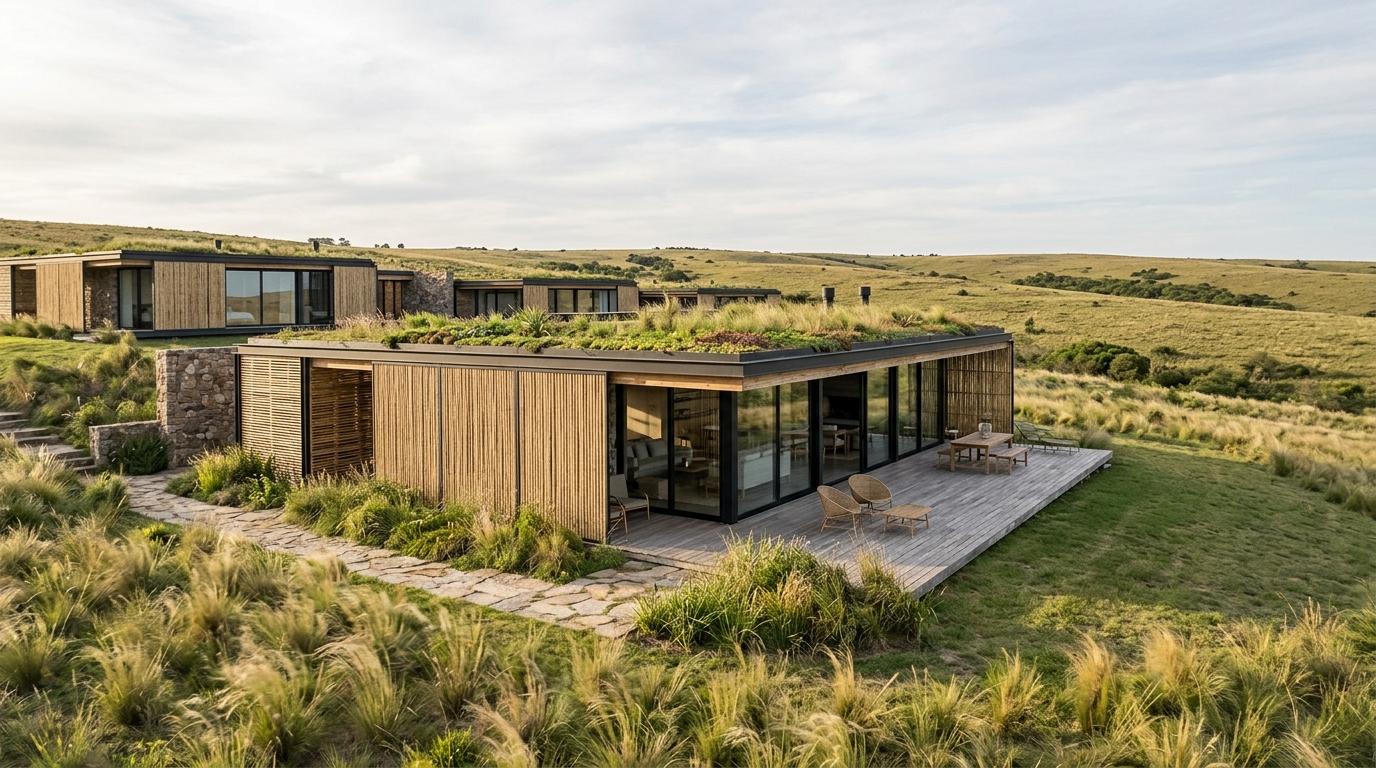
The countryside retreat is being quietly redefined by a material most people last encountered as garden furniture. Engineered bamboo — laminated, thermally treated, and dimensionally stabilized — now allows architects to treat outdoor terraces and gardens as genuine living spaces rather than decorative afterthoughts. Combined with biophilic design principles that measure how natural materials shape human wellbeing, this approach turns a Pueblo Garzón property into one continuous environment instead of a sequence of indoor rooms and unused land.
This is not a trend story. It is a structural shift in how a rural home can be conceived, built, and lived in. The central argument is simple: when exterior surfaces perform as well as interior floors, the boundary between house and landscape dissolves without compromise.
Material Science Meets Sensory Design
The technical leap lies in engineered bamboo’s transformation from raw culms into laminated lumber, cross-laminated panels, and composite decking. Thermal and resin treatments address the historical weak points — termite susceptibility, moisture absorption, and inconsistent quality — that once kept bamboo out of serious construction. The result is a decking and cladding material that withstands weather, resists decay, and maintains dimensional integrity across seasons.
According to Grand View Research, the bamboo construction materials sector closed last year at USD 100.5 billion, is expected to reach approximately USD 105.0 billion by the end of 2026, and projects to USD 142.9 billion by 2033. Residential construction accounts for nearly half of total demand, while interior applications are growing fastest.
- USD 100.5 billion — 2025 global market value
- USD 105.0 billion — 2026 projected value
- USD 142.9 billion — 2033 projected value
- 4.5 percent — compound annual growth rate through 2033
Biophilic design supplies the conceptual framework. Rather than treating greenery as decoration, the methodology integrates natural elements, natural analogues, and spatial arrangements that evoke refuge, prospect, and complexity. Three categories organize the approach: direct experience of nature, indirect experience through materials and patterns, and the experience of space itself.
not simply adding plants to a room
That phrase captures the distinction between decoration and methodology. Natural wood — including engineered bamboo — operates across all three categories as a multi-sensory material. Grain and knot patterns create organized complexity, tactile warmth differs fundamentally from metal or concrete, and acoustic behavior resembles forest environments. Natural volatile compounds such as terpenes produce measurable psychophysiological responses.
Those responses are documented, though the evidence base remains largely observational and tied to specific climates. Studies report reductions in salivary cortisol of up to twelve percent, an average seven percent decrease in systolic blood pressure after fifteen minutes of exposure, and heart rate variability gains of eight percent. Accuracy on sustained-attention tasks improved by thirteen to fifteen percent in some settings.
A practical threshold governs the effect. Measurable biophilic benefits require that at least fifteen percent of visible surfaces use natural materials. The sweet spot sits between forty and forty-five percent coverage, beyond which sensory overload becomes a risk. For a Garzón terrace anchored by engineered bamboo decking and natural wood paneling, that threshold is not merely attainable — it is the natural outcome of good proportion.
Constraints deserve honest acknowledgment. High-performance natural wood panels with thermosetting resin cores reduce upkeep but cost more upfront. Living walls and advanced glazing demand irrigation, fertilization, and seasonal replanting, and can degrade within twelve to eighteen months without consistent care. Fire-resistant reinforced panels add another specification layer, achieving B-s1,d0 classification for high-rise or evacuation-route use — a standard that matters more in Montevideo than in a low-rise rural setting.
Recent product development reflects the same trajectory. An outdoor anti-slip decking series introduced in August 2025 was specifically treated to improve weather resistance and surface grip for gardens, patios, and balconies — precisely the kind of specification that matters for a countryside terrace exposed to rain and morning dew.
Team Haverkate’s Market Read
In our work advising international buyers across Uruguay, Team Haverkate has observed a consistent gap: the desire for authentic outdoor living often outpaces the availability of locally proven materials. Engineered bamboo closes that gap for the countryside market. What makes it compelling in Pueblo Garzón specifically is not novelty but suitability — the material’s dimensional stability and weather resistance align with a climate that tests every finish.
The market data supports a forward-looking read. Bamboo flooring is the fastest-growing product segment at a 5.1 percent annual rate, while interior applications lead demand growth among end uses. Asia Pacific accounted for 44.9 percent of global revenue last year and remains the fastest-growing region, which means Latin American buyers are entering a market shaped by overseas innovation rather than local precedent. That creates an early-adopter advantage for Uruguayan properties that specify engineered bamboo correctly from the start.
From a productivity and wellness standpoint, the economic logic is sharper than most lifestyle narratives suggest. Documented effects include a fifteen percent reduction in hospital stays, a ten percent reduction in office absenteeism, and an eight percent increase in productivity. For a buyer evaluating a countryside home as both residence and retreat, these figures translate into fewer days lost to stress and more functional hours in a space designed for recovery.
Team Haverkate maintains excellent relationships with local sustainable builders experienced in engineered bamboo and biophilic design implementation — buyers interested in this approach are encouraged to reach out directly for an introduction.
The emerging direction is clear: sliding glass walls, screened porches, and winter gardens that blur interior and exterior without abandoning thermal control. Multi-sensory engagement, incorporating sound, touch, and scent, is moving from concept to specification. Design tools now include climate-based daylight modeling and material databases reporting biogenic content and embodied carbon. For Uruguay’s sober-luxury countryside market, these are not cosmetic add-ons; they are the next baseline.
A New Standard for Sober Luxury
The sober-luxury paradigm rewards restraint, material honesty, and spatial intelligence over decorative excess. Engineered bamboo fits this frame precisely. It offers visual warmth without tropical cliché, durability without industrial coldness, and sustainability without the sacrifice narrative that too often accompanies eco-conscious choices.
One structural risk that international investors often underestimate is dual agency. This occurs in Uruguay when a single real estate agent represents both the buyer and the seller in the same transaction, creating a fiduciary contradiction that undermines the purchase. With one professional incentivized by both parties, independent counsel on property valuation, title history, and liability exposure becomes harder to secure — leaving the buyer vulnerable to inflated pricing and concealed obligations.
The vision of a Garzón home where terraced living and indoor space share one material language speaks directly to Team Haverkate’s role as a trusted guide for international buyers entering Uruguay’s property market. From assessing land quality and orientation to connecting buyers with the right local specialists for engineered bamboo construction and biophilic landscape design, Team Haverkate ensures that the design intent, legal structure, and market positioning align from day one.
Frequently Asked Questions
What is engineered bamboo and how is it used in modern construction?
Engineered bamboo is made by laminating, thermally treating, and dimensionally stabilizing raw bamboo to create materials like laminated lumber, cross-laminated panels, and composite decking. These treatments address bamboo’s historical weaknesses such as termite susceptibility, moisture absorption, and inconsistent quality, making it suitable for decking, cladding, and other exterior or interior applications where weather resistance and structural integrity are required.
How does biophilic design improve human wellbeing?
Biophilic design integrates natural elements, natural analogues, and spatial arrangements that evoke refuge, prospect, and complexity. Documented effects include reductions in salivary cortisol of up to twelve percent, a seven percent average decrease in systolic blood pressure after fifteen minutes of exposure, heart rate variability gains of eight percent, and a thirteen to fifteen percent improvement in sustained-attention task accuracy.
What percentage of natural materials is needed to achieve biophilic benefits?
Measurable biophilic benefits require that at least fifteen percent of visible surfaces use natural materials. The optimal range is between forty and forty-five percent coverage, beyond which sensory overload may become a risk.
What is the market outlook for bamboo construction materials?
The bamboo construction materials sector closed last year at USD 100.5 billion and is expected to reach approximately USD 105.0 billion by the end of 2026, projecting to USD 142.9 billion by 2033. This represents a compound annual growth rate of 4.5 percent. Bamboo flooring is the fastest-growing product segment at 5.1 percent annually, and interior applications lead demand growth among end uses.
Why is engineered bamboo suitable for countryside properties in Uruguay?
Engineered bamboo offers dimensional stability and weather resistance that align well with Uruguay’s climate, making it ideal for terraces and outdoor living spaces. In Pueblo Garzón, this material allows architects to treat outdoor areas as genuine living spaces, dissolving the boundary between house and landscape. Since Asia Pacific drives most market innovation, Latin American buyers can gain an early-adopter advantage by specifying engineered bamboo correctly from the start.
What are the constraints or maintenance considerations when using natural materials and biophilic design?
High-performance natural wood panels with thermosetting resin cores cost more upfront. Living walls and advanced glazing require regular irrigation, fertilization, and replanting, and can degrade within twelve to eighteen months without consistent care. Fire-resistant reinforced panels add another specification layer, but this standard matters more in dense urban settings than in low-rise rural properties.
How does ‘sober luxury’ relate to engineered bamboo and biophilic design?
Sober luxury rewards restraint, material honesty, and spatial intelligence over decorative excess. Engineered bamboo fits this by offering visual warmth, durability, and sustainability without tropical cliché or industrial coldness. This approach supports a Garzón home where terraced living and indoor space share one material language, emphasizing functionality and recovery rather than ornamentation.