YOUR TAKEAWAYS
- Corporate Migration Surge: The EU-Mercosur Services Chapter removes regional barriers, triggering an influx of European banking and tech firms establishing headquarters in Uruguay.
- High-Yield Corporate Rentals: The influx of highly paid European executives and tech nomads creates massive, sustained demand for premium, tech-enabled residential rentals in Carrasco, Punta Carretas, and Punta del Este.
- The Ultimate Legal Safe Haven: Due to the treaty’s omission of an ISDS chapter, EU corporations must rely on local property laws, making Uruguay’s constitutional protections the deciding factor for safe foreign investment.
The Liberalization of the Mercosur Service Economy
The ratification of the newly signed EU-Mercosur Interim Trade Agreement (iTA) in January 2026 marks a monumental pivot in transatlantic economic policy. While much of the global discourse has centered on agricultural tariffs and manufacturing exports, the true engine of this geopolitical pact lies in the activation of the “Services and Establishment” chapter. This specialized legal framework explicitly removes long-standing discriminatory barriers for European firms attempting to provide financial, telecommunications, and digital services within the Mercosur bloc.
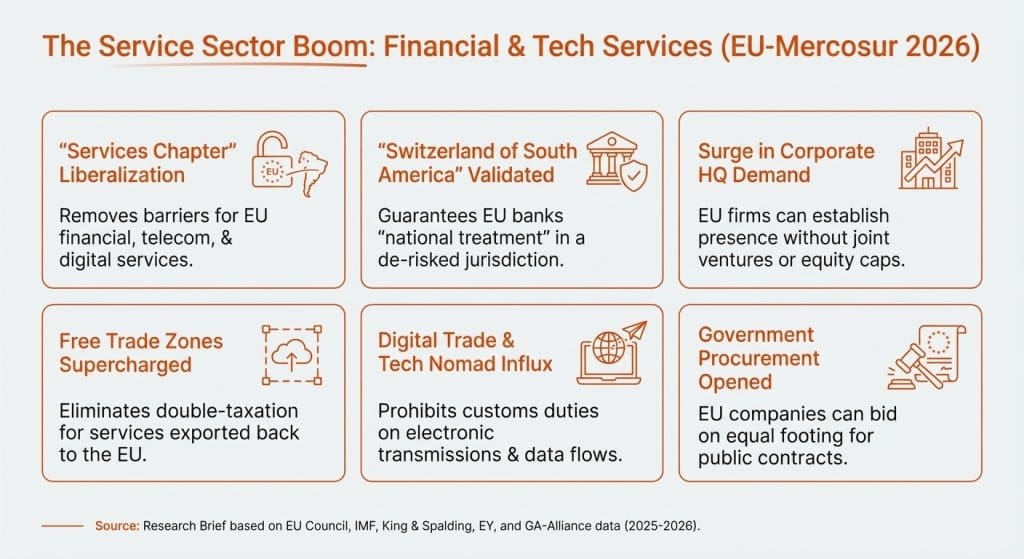
Historically, foreign service providers in South America faced a labyrinth of protectionist policies, including mandated joint ventures, severe foreign equity caps, and restrictive localized data storage requirements. The 2026 agreement dismantles these hurdles, granting European banking, technology, and consulting conglomerates “national treatment” across Mercosur. Consequently, this policy shift is acting as an unprecedented catalyst for white-collar corporate migration from the European Union directly into the South American market.
Uruguay Validated as the “Switzerland of South America”
While the agreement applies to all Mercosur nations, Uruguay has immediately emerged as the premier, de-risked jurisdiction for European corporations looking to establish their Latin American headquarters. According to the IMF’s 2025 Article IV Consultation and recent US State Department Investment Climate Statements, Uruguay’s banking system holds historically high liquidity and capital buffers, easily passing recent global stress tests.

This macro-financial stability starkly contrasts with the chronic fiscal volatility often seen in neighboring Argentina and Brazil. By guaranteeing European financial institutions equal footing, the EU-Mercosur pact synthesizes with Uruguay’s pre-existing advantages: absolute financial secrecy laws for non-residents, strict adherence to zero capital controls, and robust oversight by the Superintendency of Financial Services (SSF). Furthermore, the SSF’s aggressive push into “open finance” aligns Uruguayan digital banking infrastructure flawlessly with European GDPR and PSD2 standards, creating a frictionless, plug-and-play environment for expanding EU fintechs.
The Supercharged Free Trade Zones and Corporate Real Estate
The legal ability for EU service providers to establish a commercial presence without foreign equity caps is triggering an immediate, high-volume demand for Class-A commercial real estate. At the center of this corporate land grab are Uruguay’s globally recognized Free Trade Zones (Zonas Francas), such as Zonamerica and the World Trade Center Free Zone in Montevideo.
These zones already offer foreign corporations a 100% exemption from corporate income tax. Under the new EU-Mercosur framework, these enclaves are now seamlessly integrated into the European digital supply chain, effectively eliminating double-taxation hurdles for services exported back to the EU. Additionally, the agreement’s specific protocols prohibiting customs duties on electronic transmissions and ensuring cross-border data flows are supercharging the digital economy.
Furthermore, the opening of government procurement to EU firms allows European companies to bid on equal footing for lucrative public contracts in Uruguay, particularly in telecommunications and digital infrastructure. This legislative opening is driving an influx of European C-suite executives, project managers, and highly paid tech workers into the Uruguayan capital.
Punta del Este’s Transformation and The Strategic Legal Loophole
The impact of this corporate migration extends far beyond Montevideo. The brand-new World Trade Center Free Zone in Punta del Este is perfectly timed to absorb the new wave of European financial service firms expanding into the region. This is fundamentally transforming Punta del Este from a seasonal luxury resort town into a year-round, high-finance offshore hub, profoundly altering local real estate dynamics.
Crucially, global legal analysts have identified a strategic nuance within the EU-Mercosur iTA: the notable omission of a specific Investor-State Dispute Settlement (ISDS) or “Investment Protection” chapter. Because the international treaty lacks this specific overarching protection mechanism, European investors and corporations are forced to rely entirely on domestic laws to protect their physical assets and capital. In this regard, Uruguay stands alone in Mercosur. The Uruguayan Constitution explicitly and fiercely protects private property rights, treating foreign investors identically to domestic citizens without exception. This domestic legal bedrock effectively renders Uruguay the only truly safe jurisdiction in the bloc to park substantial physical capital and real estate assets.
Team Haverkate Analysis
The activation of the EU-Mercosur “Services Chapter” definitively crowns Uruguay as the offshore financial and digital capital for European business in Latin America. For our US and European investor clients, this macro-economic shift translates into a guaranteed, high-volume influx of corporate executives, banking professionals, and tech nomads. The investment thesis has evolved rapidly: we are moving beyond simply acquiring coastal vacation homes and must strategically pivot toward capturing elite, corporate-backed rental yields driven by international treaty law.
To capitalize on this 2026 corporate migration, we strongly advise our clients to target two specific asset classes. First, acquiring Class-A commercial real estate within or adjacent to Montevideo’s Free Zones. Second, developing or purchasing premium, tech-enabled corporate residential rentals in prime Montevideo neighborhoods like Carrasco and Punta Carretas, as well as the immediate vicinity of the Punta del Este WTC. These highly paid expatriates demand 1-to-2 bedroom smart apartments with European-standard amenities. Because Uruguay’s Digital Nomad Visa seamlessly complements the cross-border digital trade rules, the tenant pool for these premium properties is both highly capitalized and rapidly expanding, ensuring sustained, lucrative USD rental yields for our investors.
The Strategic Conclusion
The convergence of European corporate expansion and Uruguay’s unmatched fiscal security represents a generational wealth-building opportunity. However, executing a strategic acquisition of commercial or premium residential real estate in a rapidly accelerating market requires sophisticated, uncompromised representation. Foreign investors attempting to navigate zoning laws near Free Trade Zones or secure high-yield executive rentals must proceed with extreme caution.
The most significant threat to your capital in this booming market is the pervasive local practice of “Dual Agency,” where a single real estate agent attempts to represent both the seller’s demand for a high price and your critical need for rigorous due diligence. This inherent conflict of interest consistently leads to inflated acquisition costs and compromised legal security for foreign buyers.
Team Haverkate actively rejects this model, operating exclusively as your Exclusive Buyer’s Agent. Our fiduciary duty is strictly bound to you, the investor. We leverage our deep market foresight and forensic legal coordination to ensure you safely acquire the most lucrative assets driven by the EU-Mercosur corporate boom. To secure your position in Montevideo’s prime districts or Punta del Este’s new financial hub, contact Team Haverkate today for a comprehensive, confidential consultation available in English, German, French, or Dutch.