KEY POINTS
- Early integration of environmental data in building design reduces long-term energy demand and urban heat.
- Montevideo’s central districts lack green infrastructure despite a policy push to concentrate population there.
- Artificial intelligence in urban design must remain under human oversight to preserve quality outcomes.
Integrating solar orientation, building massing, and vegetation into the earliest stages of architectural design could cut energy demand and reshape how Montevideo grows, according to Jonathan Natanian, a doctor of architecture and researcher at Israel’s Technion who visited Uruguay this week.
The architect presented his findings at the Habitar event in Punta del Este, a forum first noted by El País. Natanian’s core argument is that environmental analysis should sit on the architect’s desk from the first draft, not as an afterthought.
He points to Montevideo’s architectural diversity—from colonial influences to art deco and modernism—and its “human scale,” especially in Ciudad Vieja, as qualities worth preserving. But many urban areas have drifted away from that pedestrian-friendly intimacy, he says.
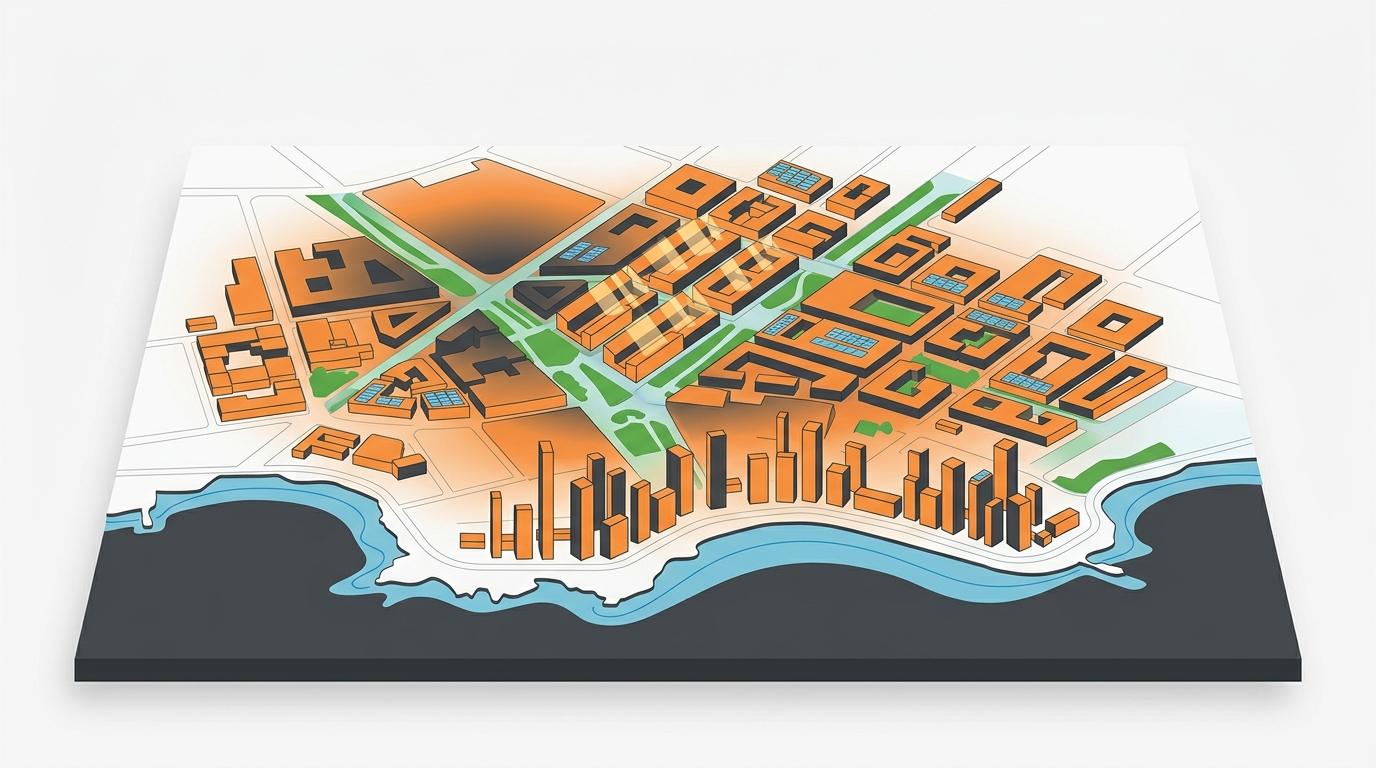
Natanian’s laboratory at Technion, the Israel Institute of Technology, develops methods to simulate how sun exposure, thermal regulation, and building orientation affect both interior comfort and public space. By adjusting a building’s rotation, for example, designers can reduce reliance on artificial lighting and climate control, lowering long-term energy costs.
The research also addresses urban heat islands—temperature differences of several degrees between city zones caused by concentrated construction and hard surfaces. Facades, depending on their material and orientation, can raise street-level heat, but strategic placement of street trees, green roofs, and vegetated walls can counteract that effect.
Natanian highlights a paradox in Montevideo: lower-income peripheral neighborhoods often enjoy better access to ecosystem services such as temperature regulation, air quality, and bird habitat, while the more densely built central areas—where authorities want to concentrate population—lack these benefits. He says current practice too often designs the building first and then calls in landscape architects to add greenery, rather than integrating vegetation from the outset.
Solar panels, increasingly common in Israel as technology matures, remain rare in Uruguay but could significantly improve the energy balance of new buildings, Natanian notes. His lab also employs artificial intelligence to explore near-infinite design possibilities, but he cautions that AI must remain a tool controlled by humans—not a replacement for human judgment. Handing everything to the AI might make life easier, but it does not guarantee better results, he argues.
Uruguay’s official gazette recently included urban planning measures addressing heat-island mitigation, biodiversity restoration, and contaminant reduction, signaling that public policy is beginning to align with this technical agenda.
Urban Planning as a Competitive Advantage for Uruguay
For international investors and expatriates, forward-looking urban design translates directly into long-term property value and quality of life. Uruguay already ranks first in South America and 35th globally in the 2026 Global Relocation Index, with notable strengths in housing affordability and foreign property rights. A municipality that systematically integrates environmental intelligence into zoning and construction standards could further differentiate Montevideo from regional peers—reducing energy costs, improving public health, and enhancing the walkable, temperate character that already defines its most desirable districts.