Key Points
- Inflation Shield: Productive Uruguayan farmland offers a powerful hedge against currency debasement with steady appreciation.
- Turnkey Operations: European investors are securing passive, dollar-denominated yields through professionally managed agricultural assets.
- Natural Capital: The future of land valuation integrates traditional commodity yields with verified carbon sequestration and renewable energy.
Table of Contents
- The Harsh Truth of Fiat Debasement
- Quantifying the Pampa Advantage
- The Green-Linked Revolution in Uruguayan Forestry
- Turnkey Farming and the Luxury-Agri Transition
- Team Haverkate Analysis: Navigating the Institutional Shift
- Executing the Sovereignty Playbook
- Securing Your Legacy: The Fiduciary Imperative
The Harsh Truth of Fiat Debasement
The harsh reality of modern wealth preservation is that holding cash or traditional equities in an era of relentless fiat debasement is a guaranteed loss of purchasing power. Savvy global investors are rapidly pivoting away from volatile paper assets and seeking refuge in tangible, productive resources. For those watching the shifting global economic landscape, the search for stability leads directly to the fertile soils of South America.
This shift is precisely why Uruguayan agricultural land prices have maintained a steady 8.4% compound annual growth rate (CAGR) over the past decade, outperforming most global REITs as a hedge against currency debasement, according to the 2026 Ministry of Livestock, Agriculture and Fisheries (MGAP) Land Value Report. For European institutional investors and family offices, the goal is no longer just capital preservation. The objective is securing hard assets that generate a reliable, annual yield in dollars, alongside consistent land appreciation.
This dual mandate is the driving force behind the surge of interest in buying property in Uruguay. We are witnessing a massive transition toward productive farms that offer both financial utility and lifestyle accessibility. It is no longer about simply acquiring a summer retreat; it is about anchoring wealth in a jurisdiction known for its profound political stability and respect for private property rights.
Quantifying the Pampa Advantage
Market Intelligence & Data
Average Price per Hectare
The average transaction price for high-productivity cattle land has reached a new peak in Q1 2026, according to the DIEA (Directorate of Agricultural Statistics).
DACH Investor Growth
Real estate inquiries from Germany, Austria, and Switzerland for productive rural assets have surged by 12.5% year-over-year, per the Uruguayan Chamber of Real Estate (CIU).
Agri-Export Valuation
Uruguay’s annual agricultural exports hit a record $5.8 billion in 2025, solidifying the income potential for land owners, according to the Central Bank of Uruguay (BCU).
Renewable Grid Integration
Investors are attracted by Uruguay’s nearly 95% renewable energy grid, which significantly lowers the operational carbon footprint of rural estates, as cited by the Ministry of Industry, Energy and Mining (MIEM).
The data paints a clear picture of a market maturing into a high-yield, institutional-grade asset class. The Uruguayan interior is currently experiencing a historic transition from traditional commodity ranching to sophisticated, tech-enabled agribusiness. Smart money is flowing into these countryside properties because they offer a unique blend of financial security and operational transparency.
Global family offices, particularly from the DACH region, are prioritizing this exact model for long-term capital preservation. They recognize that the foundational strength of the Uruguayan economy provides a safe harbor from European regulatory overreach and energy volatility. The appeal is deeply rooted in the tangible nature of the asset class.
When you acquire highly productive soil, you are buying into a global necessity that operates independently of stock market fluctuations. The integration of Uruguay’s nearly 95% renewable energy grid further enhances the appeal, significantly lowering the operational carbon footprint of these rural estates. This allows European investors to align their portfolios with strict ESG mandates while still capturing robust agricultural yields.
The Green-Linked Revolution in Uruguayan Forestry
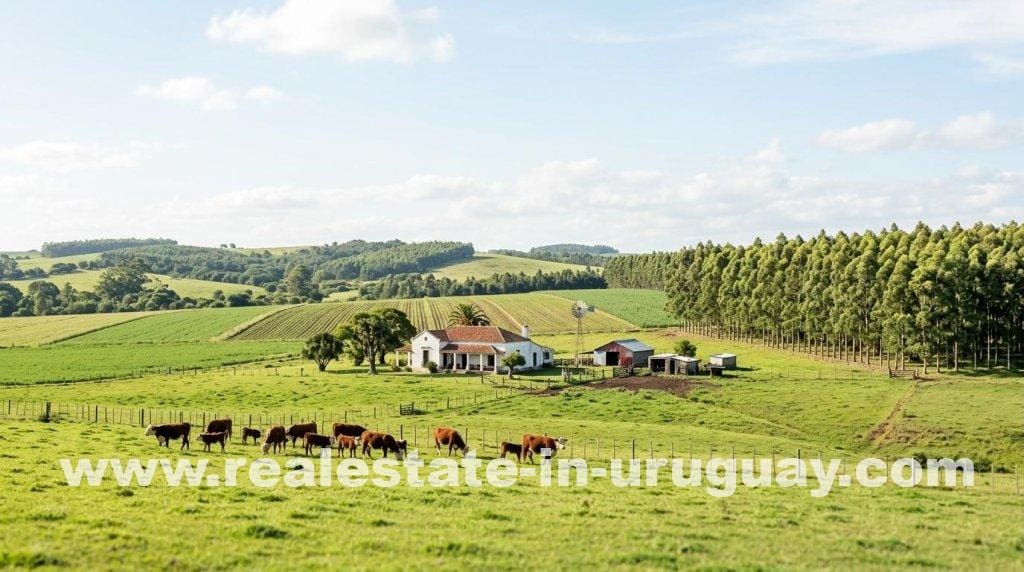
Investment is increasingly concentrating on dual-purpose land that supports intensive cattle grazing or soy rotation alongside large-scale forestry. This diversification is the ultimate shield against localized agricultural volatility. By stacking different revenue streams on the same acreage, owners can smooth out the cyclical nature of commodity pricing.
As of mid-2026, over 1.3 million hectares of Uruguayan land are now under certified sustainable forestry management, representing a 15% increase in ‘Green-Linked’ real estate transactions over the last 24 months, as reported by the Uruguay XXI Investment Agency. This staggering growth highlights the massive shift toward regenerative agri-tech and sustainable land management. Major players, including institutional timberland investment groups like BTG Pactual, are heavily driving this consolidation.
Firms are now integrating satellite soil-monitoring with carbon credit generation to maximize the utility of every hectare. Startups specializing in fractional land ownership are even beginning to democratize access to this highly coveted Pampa soil. The result is a highly liquid, transparent market that operates with the efficiency of a modern financial exchange, yet is backed by the undeniable reality of physical earth.
Turnkey Farming and the Luxury-Agri Transition
The market is increasingly defined by turnkey farming models designed specifically for the international buyer. In this arrangement, European investors acquire land managed by local professional operators, ensuring a passive, dollar-denominated yield. This structure allows owners to enjoy the financial benefits of the asset without the daily operational friction of managing farmhands or machinery.
We are seeing a specific surge in demand within departments like Florida and Lavalleja. In these regions, the proximity to Montevideo and its international port is perfectly balanced with high-index soil productivity, measured locally by CONEAT scores. This creates a unique blend of financial utility and lifestyle accessibility that is highly attractive to absentee owners.
Historically, the primary friction for international buyers was the gap between the rugged infrastructure of the interior and the luxury standards expected by high-net-worth individuals. The market is aggressively solving this through luxury-agri developments that leave absolutely nothing to chance. Historic estancia renovations now feature high-speed Starlink connectivity, off-grid energy independence via solar and lithium storage, and European-standard insulation.
Specialized architectural firms are disrupting the market by designing certified passive manor houses on working ranches. These bespoke properties are engineered to meet the strict climate-controlled demands of Northern European buyers. It is now entirely possible to oversee a multi-million dollar soy harvest from the comfort of a hyper-insulated, off-grid luxury estate.
Team Haverkate Analysis: Navigating the Institutional Shift
When analyzing this macroeconomic shift, Team Haverkate views productive Uruguayan land as the ultimate defensive portfolio play. The era of simply holding land for speculative appreciation is over; today’s market rewards active, yield-generating utility. The next evolution of this market is the natural capital era, where the true value of a ranch will be determined by its verified carbon sequestration capacity alongside its traditional beef tonnage.
We anticipate a rapid, sustained rise in boutique ecological estates that combine certified organic production with ultra-luxury hospitality. These estates cater to a global elite that increasingly views food security and water sovereignty as the ultimate luxury assets. For CEOs and institutional leaders, this represents a profound transition from simple real estate holding to owning a critical, sustainable node in the global supply chain.
Areas surrounding Pueblo Garzon are already seeing this blend of high-end lifestyle and productive organic farming take root, creating a blueprint for future developments. Professional asset management firms now seamlessly handle the legal complexities of Uruguayan tax residency and agricultural export logistics. This comprehensive support structure offers a truly frictionless remote owner experience, allowing European investors to scale their holdings with confidence.
Executing the Sovereignty Playbook
Strategic Trajectory
- Leverage Natural Capital Valuation: Restructure estate portfolios around verified carbon sequestration capacity alongside traditional beef and crop tonnage.
- Develop Boutique Ecological Estates: Blend certified organic production models with ultra-luxury hospitality to appeal to high-end global investment portfolios.
- Address Food and Water Sovereignty: Target assets that secure critical resources, positioning them as premier defensive hedges against global market instability.
- Transition to Sustainable Supply Nodes: Pivot from passive land ownership to actively managing critical operations within the global eco-conscious supply chain.
Executing this strategy requires a meticulous, data-driven approach to asset selection and operational structuring. Investors must look far beyond the raw acreage and rigorously evaluate the specific CONEAT scores, water access rights, and logistical infrastructure of the property. The goal is to build a resilient, multi-faceted portfolio that thrives regardless of global geopolitical turbulence.
Successful deployment of capital in the Uruguayan interior relies heavily on partnering with the right agronomists and local operators. It is crucial to establish clear performance metrics for turnkey operators, ensuring that soil health is maintained alongside annual yield generation. By prioritizing regenerative practices, investors protect the long-term capital value of the land while maximizing immediate cash flow.
Securing Your Legacy: The Fiduciary Imperative
Acquiring productive farmland in Uruguay is a generational wealth strategy that demands absolute precision and trustworthy local representation. The stakes are simply too high to navigate this institutional-grade market without a dedicated advocate. Unfortunately, the industry standard in many Latin American real estate markets is a practice that inherently compromises the buyer’s position and financial security.
We strongly warn international investors to avoid dual agency, a dangerous scenario where a single broker attempts to represent both the buyer and the seller. This creates a severe, unmanageable conflict of interest and frequently leads to inflated land valuations and hidden operational liabilities. You cannot negotiate effectively when your representative is financially incentivized to maximize the seller’s profit.
Team Haverkate operates strictly against this outdated model, serving exclusively as a dedicated buyer’s agent. Our sole fiduciary responsibility is to protect your capital with independent legal, agronomic, and financial oversight. We ensure that your acquisition of productive Uruguayan soil is executed flawlessly, transparently, and at true market value.
To begin structuring your agricultural portfolio and securing your natural capital, contact Team Haverkate today. Our expert advisory team is ready to assist you in English, German, French, or Dutch.
Frequently Asked Questions
Is Uruguayan agricultural land a good hedge against inflation and currency debasement?
Yes. According to the 2026 MGAP Land Value Report, Uruguayan agricultural land has maintained an 8.4% compound annual growth rate (CAGR) over the past decade. This outperforms most global REITs and provides a stable, dollar-denominated yield as fiat currencies lose purchasing power.
What are CONEAT scores, and why are they important for buyers?
CONEAT scores are a specialized local metric used in Uruguay to measure soil productivity and potential agricultural yield. Evaluating these scores is a critical step in the due diligence process to ensure the land meets the specific productivity requirements for cattle, crops, or forestry.
Can European investors manage Uruguayan farmland remotely?
Absolutely. Many international investors utilize a “turnkey farming” model where land is managed by professional local operators. This structure provides a passive, dollar-denominated yield and allows owners to oversee their investment without the daily friction of managing agricultural operations.
What makes Uruguay’s forestry sector attractive for green-linked investment?
Uruguay has over 1.3 million hectares of certified sustainable forestry. The sector is increasingly focused on “green-linked” real estate, which integrates traditional timber yields with carbon credit generation and satellite soil-monitoring to maximize the utility and ESG value of the land.
Why should international buyers avoid dual agency in Uruguay?
Dual agency occurs when one broker represents both the buyer and the seller, creating a severe conflict of interest. To avoid inflated valuations and hidden liabilities, investors should work with a dedicated buyer’s agent like Team Haverkate, who maintains a sole fiduciary responsibility to the buyer.
How does Uruguay’s renewable energy grid benefit rural estate owners?
Uruguay’s grid is nearly 95% renewable, significantly lowering the operational carbon footprint of rural estates. This allows European institutional investors and family offices to align their agricultural portfolios with strict international ESG mandates while enjoying lower energy costs.