KEY POINTS
- Uruguay’s diesel price rose 7.33% to $1.566 per liter, moving to sixth in Latin America.
- The government approved a 7% increase despite the regulator’s 37% reference, maintaining price controls.
- The Ministry of Economy is evaluating shifting urban bus subsidies from diesel to gasoline to ease burdens on productive sectors.
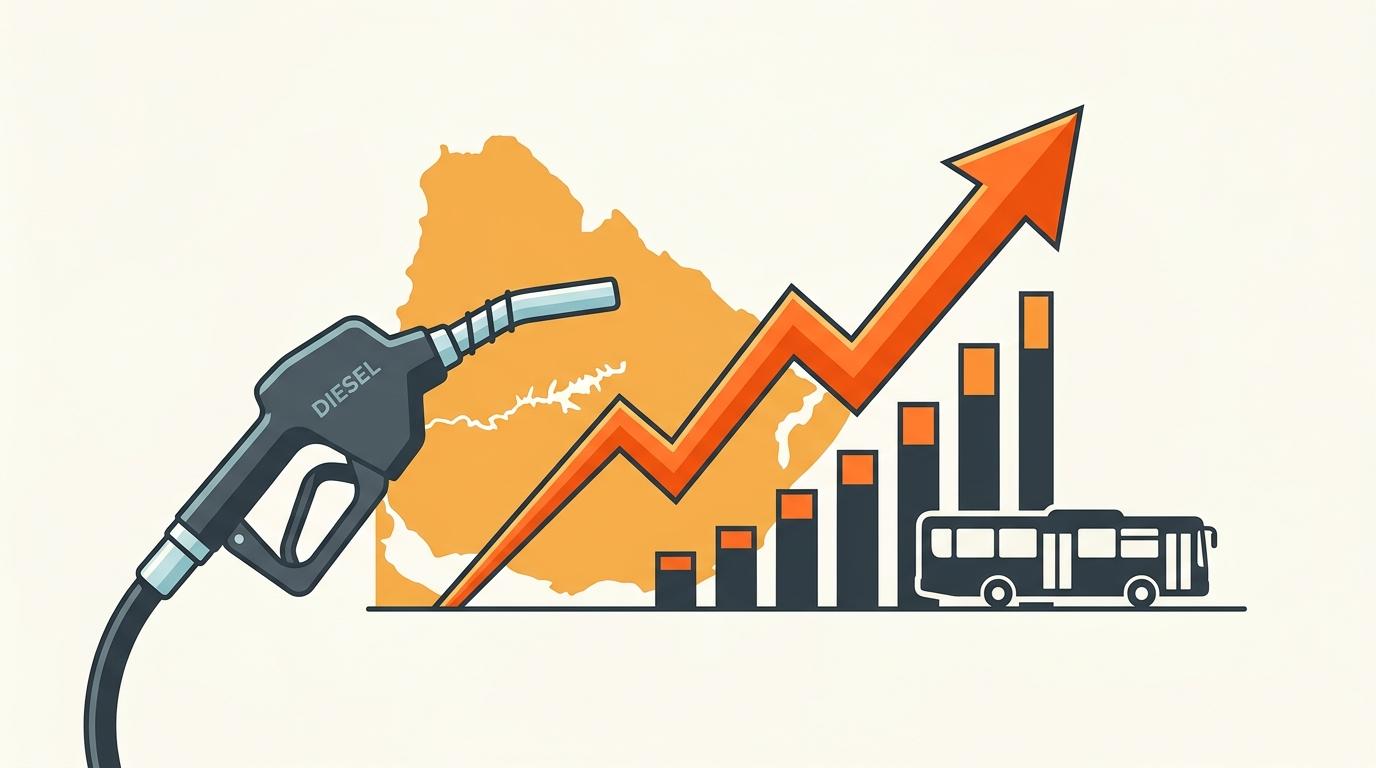
Uruguay’s diesel price climbed to $1.566 per liter following a 7% government-approved increase on October 1, lifting the country from seventh to sixth place in Latin America’s regional fuel ranking. The month-on-month rise of 7.33% in local diesel values contrasted with a relatively stable regional average of $1.39 per liter.
This was the executive branch’s first fuel adjustment in four months, and it did not fully transfer international reference prices; the national energy regulator had estimated that a complete pass-through would require an increase of up to 37%. Meanwhile, the regional average rose 5.3% from September but remained 11.24% below Uruguay’s national price.
Cuba led the ranking at $2.00 per liter, followed by Peru at $1.912, Jamaica at $1.793, Costa Rica at $1.718, and Argentina at $1.602. Paraguay placed eighth at $1.503, while Brazil sat in sixteenth at $1.330 per liter, according to data compiled by Global Petrol and processed by SEG Ingeniería, as first reported by Ámbito.
Government continues to exercise firm control over diesel pricing; the 7% increase is well below the 37% reference adjustment, reflecting a policy of shielding the productive sector from full international volatility. Diesel sold to the public includes a surcharge over import cost that finances the Sustainable Mobility Trust Fund, a fund covering the difference between what transit users pay and the actual cost of a bus ticket.
This cross-subsidy means cargo transport, agriculture, and industry effectively underwrite a portion of urban passenger transit costs—a burden those sectors have long opposed. Economy Minister Gabriel Oddone said he is evaluating the change and is in principle favorable to making subsidy-setting more transparent, while cautioning that any transition carries costs that must be carefully assessed.
Cost Pressures and Investor Implications
The diesel price adjustment and the review of fuel-linked subsidies underscore how Uruguay manages input costs that affect logistics, agro-exports, and construction. For international investors, stable diesel pricing below international parity helps anchor operating costs in key sectors, even as the potential shift of bus subsidies from diesel to gasoline could rebalance tax incidence and improve competitiveness for diesel-dependent industries. This measured approach supports Uruguay’s reputation as a predictable market for long-term capital deployment.