Key Takeaways
- Uruguay produced 1,300 tons of olive oil in 2026, still 10% below the five-year average, leaving it a net importer of 2,200 tons in 2025.
- The 8.4% EU import tariff will phase out over a decade under the EU-Mercosur agreement, eroding local producers’ price advantage.
- Uruguay’s preferential trade access to Europe via EU-Mercosur and EFTA-Mercosur strengthens its case as a base for agribusiness and export-oriented ventures.
Table of Contents
A Production Rebound Meets a Tariff Countdown
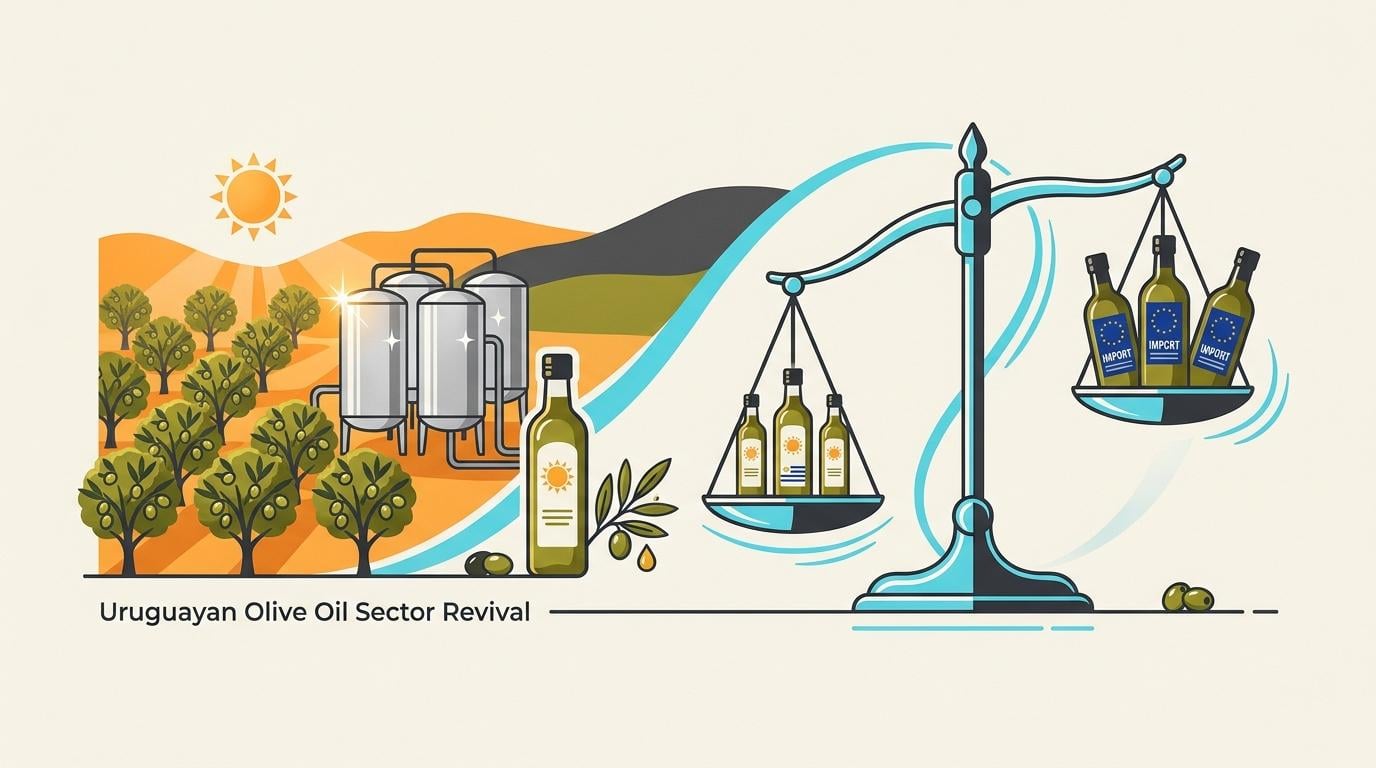
Uruguay’s olive oil mills turned out 1,300 metric tons in 2026, a second consecutive annual increase, according to Olive Oil Times. The recovery still leaves the country a net buyer of olive oil just as an 8.4% tariff on European Union imports begins a decade-long phase-out under the EU-Mercosur agreement.
The tension is no longer just about weather. El Niño rains replenished soil after the droughts that crushed the 2024 harvest, but trade policy will now shape the sector’s economics more than rainfall does.
Why a Recovery Still Leaves Uruguay a Net Buyer
The 2026 crop beat the 1,273 tons produced in 2025 and the 614 tons from 2024, yet it still ran 10% below the five-year average. That gap matters because local supply has not caught up with domestic demand.
Ministry data reported by Olive Oil Times show more than 11 million kilograms of olives were harvested for oil, plus 6,065 kilograms for table olives. Across 33 mills, the self-reported average oil yield reached 11.7%.
Producers sold 64% of their oil inside Uruguay and exported another 20%. Brazil, Spain, and the United States lead foreign demand, with smaller volumes going to Argentina.
Those export numbers remain modest next to import flows. Uruguay imported 2,200 tons of olive oil worth $11.6 million in 2025, while exporting 285 tons worth $1.2 million. Spanish trade agency ICEX identifies Uruguay as a strategic market for Spanish exporters.
Spain, Argentina, and Italy supply most of Uruguay’s imported oil. Local consumption has reached 0.5 liters per capita, a level ICEX frames as a shift toward health-conscious purchasing.
Extra virgin olive oil is gaining prominence due to growing health concerns and a preference for higher-quality products.
That import pressure has kept local prices flat even as bottles, phytosanitary products, and other inputs became more expensive. Average pre-tax bulk prices reached 388 Uruguayan pesos, or €8.77 per liter, while retail averaged 478.6 pesos, or €10.80 per liter.
For now, the 8.4% import duty gives local producers a price advantage. Under the provisional EU-Mercosur trade pillar, that advantage will disappear gradually, exposing domestic bottlers to lower-cost European supply.
Some producers and industry stakeholders have privately raised concerns about Uruguayan companies bottling imported oil and labeling it as Product of Uruguay. If that practice widens, price signals for genuine local production become harder for buyers to trust.
Team Haverkate’s Read: Trade Architecture Outweighs Olive Yields
In our experience advising international investors, the olive oil import gap is a narrow signal into a much larger structural shift. Uruguay now has active preferential trade agreements with virtually the entire European continent, a position no other Mercosur economy can match at this moment.
The EU-Mercosur trade pillar has applied provisionally since May 1, 2026. The EFTA-Mercosur agreement with Iceland, Liechtenstein, Norway, and Switzerland took effect for Uruguay on November 1, 2026. Latin Times data underlines the scale: the EU arrangement links more than 700 million people and over $21 trillion in combined output, while EFTA covers nearly 300 million people and more than $4.3 trillion.
Uruguay was the first Mercosur member to complete domestic approval of the EU-Mercosur interim trade agreement, clearing the lower house 91 to 2 in February 2026. For an investor looking at a regional base, that speed of ratification signals political alignment with open trade rather than resistance to it.
Uruguay placed roughly $54 million of products in EFTA markets in 2024 and imported close to $60 million. The European Union was already Uruguay’s third-largest export destination in 2025, behind China and Brazil.
But the less comfortable read comes from AgriBusiness Global. Tariff reductions and quotas phase in over years, not overnight, and Mercosur members have still not settled distribution of some quotas, especially beef.
Final approval of the broader EU-Mercosur association pillar still depends on a European Court of Justice review that could take up to two years. European safeguards, sanitary rules, the Carbon Border Adjustment Mechanism, and the EU Deforestation Regulation remain real constraints.
That uneven timing maps directly onto olive oil. A domestic producer may celebrate a good harvest and still face flat prices as imported oil fills supermarket contracts. Investors should price that tension into land, processing, or export-linked assets rather than treating a single crop year as the signal.
A Trade Pivot That Rewrites Agribusiness Math
The olive sector’s rebound is real, but it is not yet a structural turnaround. Uruguay remains a net importer, and the scheduled removal of the EU tariff will force local producers to compete on cost, packaging, and origin claims.
At the same time, the broader trade architecture has changed the country’s investment profile. Uruguay can now offer preferential access to Europe while retaining Mercosur membership, a combination that strengthens its case as a destination for agricultural processing and export-oriented ventures.
There is one risk on the buying side worth flagging as foreign capital moves into Uruguayan agribusiness and real estate: dual agency. When a single broker represents both buyer and seller, the incentive to hold the price high or smooth over hidden liabilities sits directly against the buyer’s need for independent advice. That conflict can lead to inflated valuations or a negotiation that quietly favors the other side.
Team Haverkate helps international buyers and investors separate short-term commodity noise from the policy shifts that actually move property values and business returns. For anyone structuring a cross-border agribusiness or land entry, we work closely with vetted local tax and legal specialists to keep the structure clean from day one.
Frequently Asked Questions
How much olive oil does Uruguay produce and why is it still a net importer?
Uruguay produced 1,300 metric tons of olive oil in 2026, a second consecutive annual increase over 1,273 tons in 2025 and 614 tons in 2024. Despite the rebound, output remains about 10% below the five-year average and well short of domestic demand. Uruguay imported 2,200 tons of olive oil worth $11.6 million in 2025 while exporting only 285 tons worth $1.2 million, leaving the country a structural net buyer supplied mainly by Spain, Argentina, and Italy.
How does the EU-Mercosur agreement affect Uruguay’s olive oil sector?
The EU-Mercosur trade pillar has applied provisionally since May 1, 2026, and begins a decade-long phase-out of the 8.4% tariff on EU olive oil imports. That duty currently gives Uruguayan producers a price advantage, but its gradual removal will expose domestic bottlers to lower-cost European supply. Tariff reductions and quotas phase in over years rather than overnight, and final approval of the broader association pillar still depends on a European Court of Justice review that could take up to two years.
What makes Uruguay’s trade position unique within Mercosur?
Uruguay now holds active preferential trade agreements with virtually the entire European continent, a position no other Mercosur economy currently matches. The EU-Mercosur pillar links more than 700 million people and over $21 trillion in combined output, while the EFTA-Mercosur agreement with Iceland, Liechtenstein, Norway, and Switzerland took effect for Uruguay on November 1, 2026, covering nearly 300 million people and more than $4.3 trillion. Uruguay was also the first Mercosur member to complete domestic approval of the EU interim trade agreement, clearing its lower house 91 to 2 in February 2026.
Why are Uruguayan olive oil prices flat despite a better harvest?
Import pressure has kept local prices flat even as bottles, phytosanitary products, and other inputs became more expensive. Average pre-tax bulk prices reached 388 Uruguayan pesos (about €8.77 per liter), while retail averaged 478.6 pesos (about €10.80 per liter). Imported oil filling supermarket contracts, combined with concerns about Uruguayan companies bottling imported oil and labeling it as Product of Uruguay, weakens price signals for genuine local production.
What are the main risks for investors in Uruguayan agribusiness?
Investors should distinguish short-term commodity noise from structural policy shifts. Key risks include the phased removal of the EU tariff, unresolved Mercosur quota distribution (especially for beef), European safeguards, sanitary rules, the Carbon Border Adjustment Mechanism, and the EU Deforestation Regulation. On the property side, dual agency is a flagged concern: when one broker represents both buyer and seller, incentives can lead to inflated valuations or negotiations that quietly favor the other side, so independent advice matters.
Where does Uruguay export its olive oil and who consumes it domestically?
Producers sold 64% of their oil inside Uruguay and exported another 20%, with Brazil, Spain, and the United States leading foreign demand and smaller volumes going to Argentina. Domestic consumption has reached 0.5 liters per capita, a level the Spanish trade agency ICEX frames as a shift toward health-conscious purchasing, with extra virgin olive oil gaining prominence among quality-focused buyers.