KEY POINTS
- Electric vehicle purchase financing grew more than 40-fold from 2022 to 2026, with monthly loans peaking at 875 in March 2026.
- More than 90% of EV credit was denominated in UI (indexed units), reducing currency mismatch risk for households.
- Reliable renewable electricity and lower energy costs are driving demand, with the central bank viewing the surge as a signal of sustainable finance expansion.
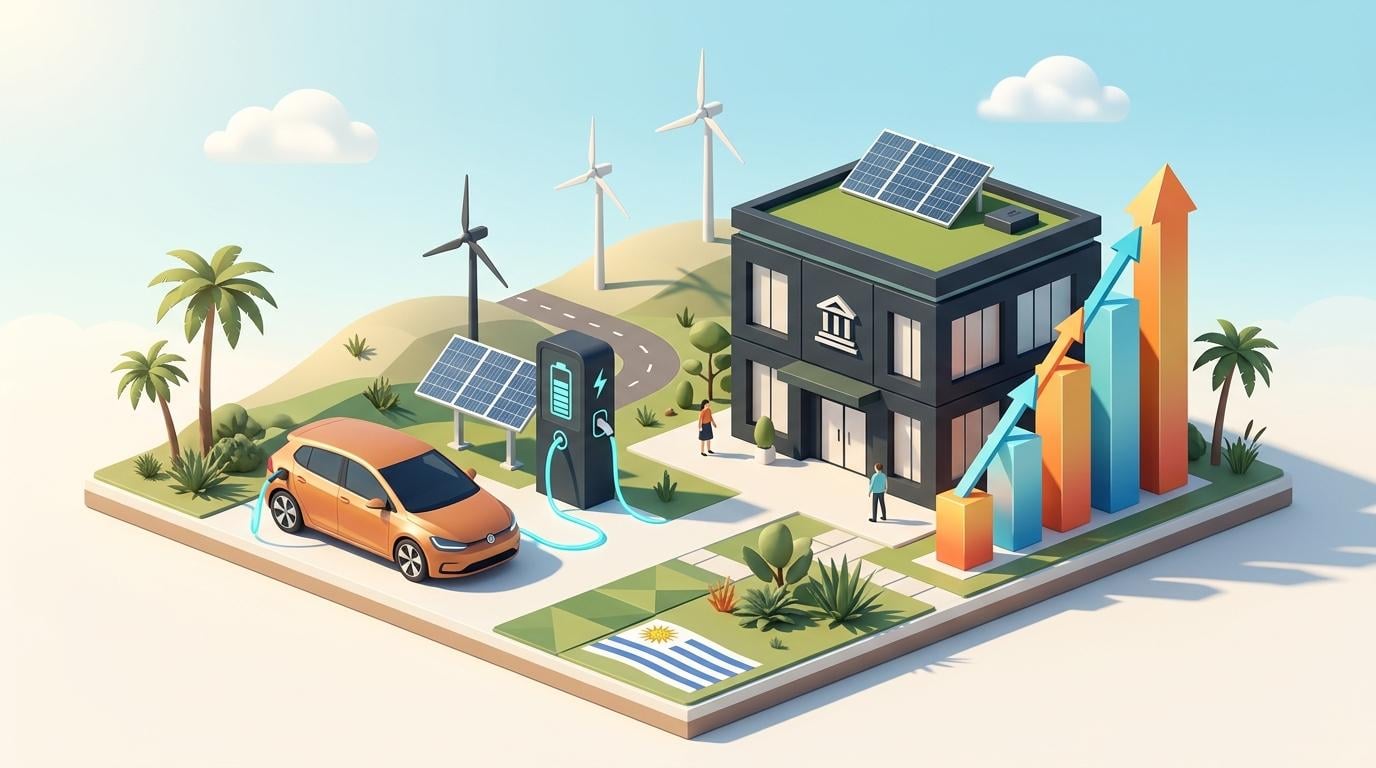
Bank financing for electric vehicle purchases in Uruguay multiplied by more than 40 times between 2022 and 2026, with monthly loan volumes climbing from fewer than 20 operations to more than 500 and peaking at 875 in March 2026. Total disbursements reached approximately US$610 million in the most recent month covered by the data.
Monthly loan volumes climbed from fewer than 20 operations early in the series to more than 500, reaching a peak of 875 in March 2026. The Central Bank of Uruguay’s Financial System Report, detailed in market coverage by Ámbito, characterizes the trajectory as decidedly expansive.
Activity was scarce through 2022 and early 2023, then entered a sustained growth phase that accelerated significantly during 2024 and 2025. The currency composition stands out: indexed units (UI) accounted for more than 90% of the total financed amount across the period.
Dollar-denominated loans grew in absolute terms but retained a limited share, with the central bank tying the preference to the alignment between household income currency and debt currency, which reduces exchange-rate mismatch risk. Average loan size remained relatively stable, with UI loans hovering around UYU 700,000 per operation for much of the recent period.
Dollar loans showed greater volatility due to their smaller operation count. This suggests the expansion was driven by a widening base of borrowers rather than larger individual loans, a dynamic the report interprets as a favorable signal for credit access in sustainable mobility.
Demand-side factors include rising household interest in sustainable mobility, strong sales of new vehicles, and the lower cost of electric energy compared to fossil fuels. Reliable electricity supply, a product of Uruguay’s decades-long renewable energy transformation, provided a supportive backdrop for both private and public electric transport.
The central bank situates the trend within broader environmental criteria in bank financing, describing the evolution of this credit segment as a relevant indicator of sustainable finance gaining traction in the system.
What the EV Credit Surge Signals for Uruguay’s Financial Depth
Uruguay’s banking sector still converts deposits into private credit at a notably low rate: domestic private credit was just 29.9% of GDP in 2024, roughly half the Latin American benchmark, while deposits reached 57.5% of GDP. That structural gap makes the EV financing expansion an exception worth watching, as it demonstrates demand-driven credit growth in a specific green segment rather than balance-sheet-driven lending.
IMF staff assessments from September 2026 place peso credit growth at about 9% in real terms year-on-year as of August, supported by lower reserve requirements and a state-owned program directing around 10% of BROU’s corporate credit portfolio to sustainable projects. For international investors and expats, the EV credit trajectory reinforces Uruguay’s rule-based financial environment and its commitment to green mobility, which supports the long-term appeal of residential and commercial real estate in Montevideo and beyond.