YOUR TAKEAWAYS
- Energy Land Banking: The $5.3B green hydrogen boom shifts rural land valuation from agricultural fertility to solar/wind potential, offering lucrative USD leasing opportunities to foreign buyers.
- Executive Housing Deficits: Paysandú faces a severe shortage of premium housing for hundreds of incoming European engineers, creating high-ROI, tax-advantaged development opportunities.
- COMAP Tax Exemptions: US and EU developers building infrastructure or housing for these green energy hubs can leverage government incentives to write off up to 100% of their investment.
A Historic $5.3 Billion European-Backed Mega-Project
The ratification of specific green energy clauses within the 2026 EU-Mercosur Trade Agreement has officially positioned Uruguay as Europe’s primary safe haven for importing certified, renewable fuels. This geopolitical shift has rapidly materialized into unprecedented foreign direct investment. The Uruguayan government and HIF Global have officially signed an agreement to develop a massive synthetic fuels project in the interior department of Paysandú. Representing a staggering $5.3 billion investment, the facility is contracted to produce 880,000 tons of e-fuels annually by 2029.
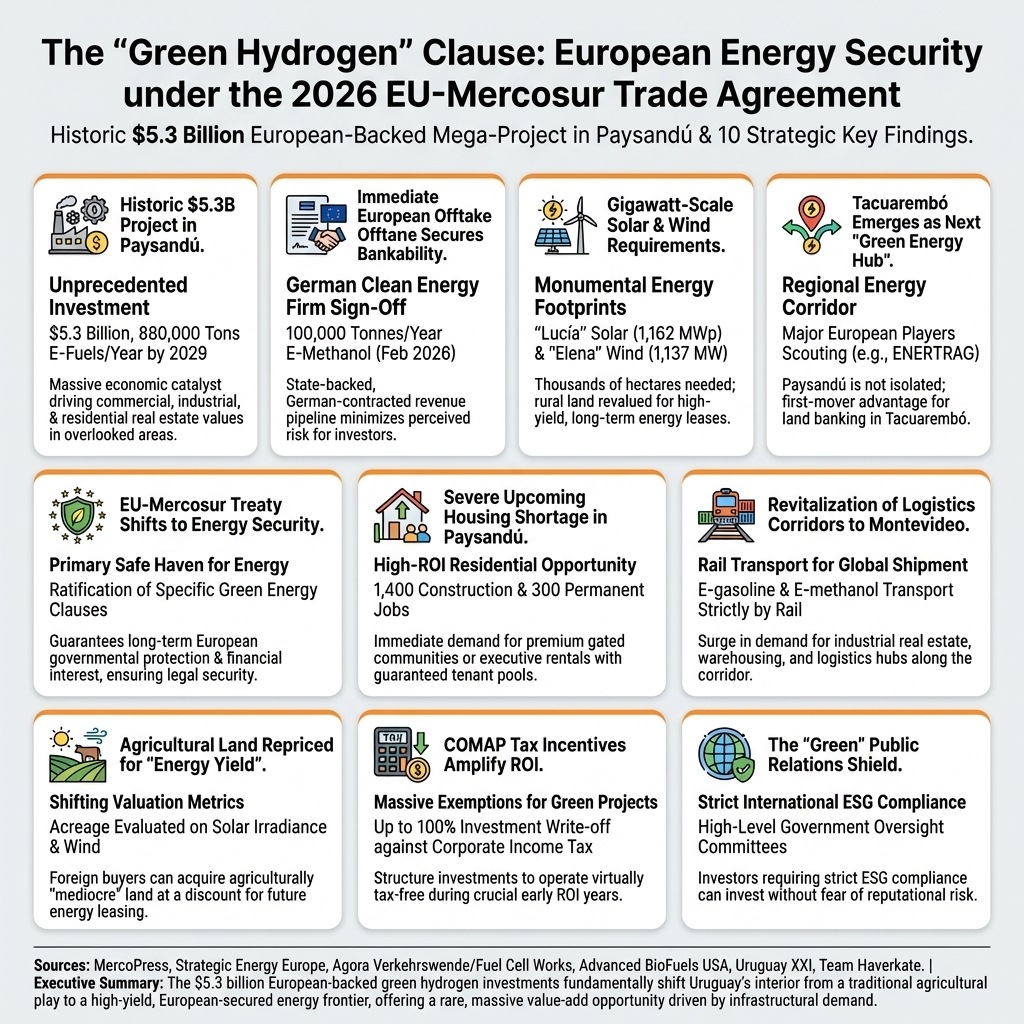
The market bankability of this monumental project was solidified in February 2026, when the German clean energy firm eFuel One GmbH signed a landmark offtake agreement. The firm committed to purchasing 100,000 tonnes of e-methanol per year directly from the Paysandú complex. This immediate, state-backed, German-contracted revenue pipeline ensures the project’s immediate profitability and legally anchors European energy security to Uruguayan soil.
For international markets, this influx of $5.3 billion into a single regional department represents a massive economic catalyst. It definitively shifts Uruguay’s interior from a traditional agricultural frontier into a high-yield, European-secured energy hub, driving profound implications for commercial, industrial, and residential real estate values in previously overlooked zones.
Gigawatt-Scale Land Requirements and Agrarian Repricing
Supplying the necessary power for these hydrogen electrolysis plants requires monumental physical footprints. The Paysandú project alone necessitates the construction of the new “Lucía” Solar Park (1,162 MWp) and the “Elena” Wind Farm (1,137 MW) in the Cuchilla de Fuego area. Consequently, thousands of hectares of rural land are urgently required.
This demand is fundamentally altering how land appraisers evaluate real estate in Uruguay’s interior. Historically, acreage was valued almost exclusively on the CONEAT index, a metric measuring soil fertility for beef and soy production. Today, appraisers and institutional buyers are shifting their metrics to evaluate land based on solar irradiance and wind consistency. Rural plots previously considered agriculturally “mediocre” are now prime targets for high-yield, long-term energy land leases paid in US Dollars.
Furthermore, the Paysandú project is not an isolated event but the anchor of a broader regional energy corridor. Major European players, including the German firm ENERTRAG, are already scouting and planning large-scale green hydrogen projects in the neighboring Tacuarembó region, expanding the footprint of this energy-driven land rush.
The Paysandú Housing Deficit and Logistics Revitalization
Beyond rural land, the green hydrogen boom is triggering an acute infrastructure and housing squeeze. The HIF project in Paysandú is slated to generate 1,400 direct construction jobs and require 300 highly paid, permanent technical and executive positions once operational. Currently, the city of Paysandú lacks the premium residential infrastructure required to house over 300 international engineers, European executives, and their families.
Simultaneously, the logistics sector is undergoing a massive revitalization. The refined synthetic e-gasoline and e-methanol produced in Paysandú will be transported strictly by rail to the Port of Montevideo for global shipment. Industrial real estate, warehousing facilities, and logistical hubs positioned strategically along this specific rail corridor are projected to experience a severe surge in demand as the 2029 production deadline approaches.
Institutional Backing and ESG Compliance
For global institutional investors, regulatory and environmental compliance is paramount. While localized debates regarding freshwater usage for hydrogen electrolysis have occurred, the creation of High-Level government oversight committees ensures these mega-projects will proceed with strict international ESG (Environmental, Social, and Governance) compliance.
The institutional backing of the EU-Mercosur Trade Agreement guarantees long-term European governmental protection and financial interest in Uruguay. Corporate and private investors from Europe and the US who require strict ESG compliance for their portfolios can inject capital into Uruguay’s green corridors without fear of reputational risk or local regulatory friction.
Team Haverkate Analysis
The historic $5.3 billion green hydrogen investment fundamentally rewrites the playbook for US and German investors looking at Uruguayan real estate. We are witnessing the birth of a dual-track market where rural land is no longer solely an agricultural play, but a high-yield utility asset. For our clients, acquiring large tracts of land with high solar or wind potential—even if the CONEAT fertility index is low—offers a rare arbitrage opportunity. Investors can purchase this land at a discount relative to prime agricultural plots, knowing its true value lies in lucrative, USD-denominated, decades-long land leases to European energy conglomerates. Furthermore, because European developers like ENERTRAG are already expanding into Tacuarembó, investors who are priced out of Paysandú currently possess a narrow first-mover advantage for land banking in these neighboring departments.
On the development side, the impending housing shortage in Paysandú is an unmissable, high-ROI opportunity. US and European developers have a guaranteed, highly capitalized tenant pool of international engineers and executives arriving imminently. Building premium gated communities or executive rentals in this region is mathematically insulated by hard infrastructural demand. This is radically amplified by Uruguay’s Investment Promotion Law (COMAP). Projects tied to sustainable development and regional decentralization frequently receive massive tax exemptions, allowing foreign developers to write off up to 100% of their investment against corporate income tax. In short, foreign developers can build essential housing for a guaranteed European tenant base while operating virtually tax-free during the crucial early years of their ROI.
The Strategic Conclusion
Uruguay’s transformation into Europe’s green energy safe haven offers unprecedented avenues for wealth generation, but capitalizing on this shift requires highly specialized local navigation. Acquiring the right parcels for energy leasing, securing COMAP tax exemptions for executive housing developments, and navigating the evolving zoning laws along the new logistics corridors are incredibly complex processes.
In a market flooded with billions in foreign capital, the risk of misallocation is high. Relying on traditional real estate agencies that practice “Dual Agency“—where the agent attempts to represent both the seller’s desire for maximum profit and the buyer’s need for rigorous due diligence—frequently results in compromised legal security and inflated acquisition costs.
Team Haverkate mitigates this risk entirely by operating strictly as your Exclusive Buyer’s Agent. Our fiduciary duty is solely to you, the investor. We provide the forensic land appraisal, legal coordination, and strategic market foresight necessary to ensure your capital is deployed safely and profitably within Uruguay’s booming green energy corridors. To secure your first-mover advantage in Paysandú, Tacuarembó, or along the Montevideo logistics route, contact Team Haverkate today for a confidential consultation available in English, German, French, or Dutch.