Key Points
- Refined Elementalism: Integrating native wood and flagstone elevates property valuations and aesthetic appeal.
- The Hybrid Shell: Merging pure decorative charm with rigorous German-engineered climate control systems.
- Hyper-Local Sourcing: Crafting sustainable, carbon-neutral interiors to meet stringent European investment standards.
Table of Contents
The Vision: Redefining Luxury Through Refined Elementalism
The architectural landscape of Punta del Este and José Ignacio is undergoing a profound shift. According to the Uruguay Real Estate Chamber (CIU), the luxury sector in Maldonado recorded a 14.5% year-over-year increase in square-meter pricing for properties featuring certified, sustainable noble materials.
This data signals the dawn of Refined Elementalism. High-end developments are moving decisively beyond sterile, traditional construction, focusing instead on turning interior spaces into a living canvas.
The Power of Biophilic Design
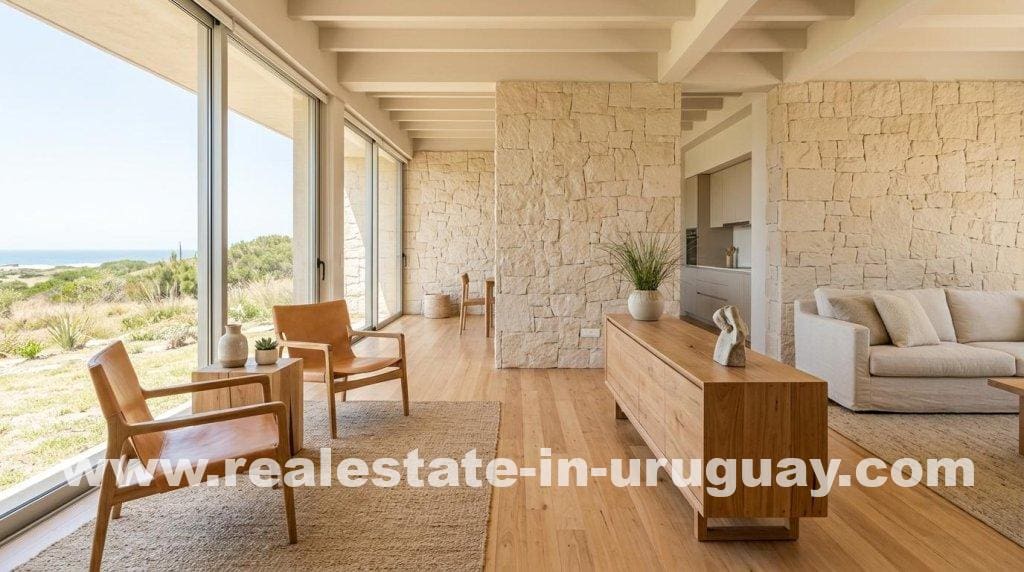
This aesthetic evolution relies on the structural integration of biophilic elements. Local flagstone (piedra laja) and native Lapacho wood are thoughtfully paired to ground each property in its natural environment.
Meanwhile, unprocessed merino wool and raw leather have evolved beyond mere decorative accents. Today, they form a fundamental part of the home’s tactile identity, satisfying both the sensory and ecological demands of the global elite.
The Uruguayan Dream
Uruguay has become the ultimate destination for this unique synergy of lifestyle and investment. The country’s vast, pristine landscapes provide the perfect backdrop for organic resources.
For international buyers—particularly those from the DACH region—this represents the realization of the Uruguayan dream: the rare opportunity to inhabit a space deeply connected to the earth, without compromising the highest echelons of modern luxury.
Market Insights & The European Benchmark
Market Intelligence & Data
Native Wood Valuation
European buyers are consistently paying a 35% premium for properties that utilize certified native Uruguayan Lapacho and Curupay woods in interior design, according to the Uruguay XXI Investment Agency.
Organic Luxury Inflow
Total foreign direct investment in ‘Organic Luxury’ developments in the Rocha and Maldonado regions reached $1.2 billion in the last fiscal year, per the Central Bank of Uruguay.
DACH Buyer Preference
A 2026 survey indicates that 82% of DACH-region investors prioritize ‘Natural and Noble Materials’ over ‘Industrial Modernity’ when selecting a second residence, according to the European Property Intelligence Group.
Resale Appreciation
Resale values for ‘Material-Authentic’ homes in Punta del Este are appreciating 20% faster than traditional concrete-centric developments, as documented by the Maldonado Association of Realtors.
The market trajectory is clear: European capital is driving a new standard in Uruguayan real estate. Historically, the main challenge for buyers from countries like Germany, Switzerland, and Austria was the gap between rustic charm and modern comfort.
Investors seeking a serene retreat in South America want the peace of the countryside, but they refuse to sacrifice the rigorous living standards and efficiency they enjoy back home. Fortunately, Uruguay’s market leaders have solved this through an innovative approach: The Hybrid Shell.
The Hybrid Shell: Organic Outside, High-Tech Inside
This architecture method uses local noble materials to create stunning, organic facades. However, behind that raw, natural surfacing lies world-class engineering.
Developers are now seamlessly embedding:
-
German-engineered climate control systems for year-round comfort.
-
Triple-glazed windows to optimize thermal efficiency.
-
Advanced acoustic insulation built directly into walls and ceilings.
The result is the exact “Pinterest-perfect” aesthetic that buyers fall in love with online, without a single compromise on performance or connectivity.
The Best of Both Worlds
This integration allows a property to perform like a cutting-edge European smart home while retaining the authentic soul of a Uruguayan estancia.
The use of raw wool and leather naturally softens the acoustic profile of expansive, high-ceiling living areas, while native woods bring a warmth that industrial materials simply cannot replicate. It is precisely this meticulous balance that is driving premium valuations across the coastal regions of Maldonado and Rocha.
The Architectural & Lifestyle Deep Dive
Tactile Interiors and Biophilic Design
Strategic capital is flowing into Turnkey Artisan Estates at an unprecedented rate. These properties are born when local master craftsmen collaborate with European architectural firms, fusing regional flagstone and native wood. This synergy ensures that rustic, raw elements are elevated to a standard of refined luxury.
Today, the market is shifting rapidly from mass-market luxury toward Slow Architecture boutiques that offer entirely carbon-neutral interiors.
High-net-worth individuals often curate their ideal second residences through platforms like Pinterest. They arrive in Uruguay with a clear vision: they want interiors that showcase the raw beauty of the South American landscape.
The tactile nature of flagstone floors and leather-wrapped fixtures provides an immediate sense of grounding. The home becomes a sanctuary designed to counteract the high-stress environment of European corporate life. By prioritizing natural, pure materials, the property transforms from a mere financial asset into a vital pillar of the owner’s personal well-being.
Ecological Performance and Sensory Comfort
Noble materials are not just visually stunning; they carry a profound cultural legacy and exceptional functional superiority. This was spotlighted when Uruguay officially declared its traditional wool production system as Intangible Cultural Heritage. This recognition celebrates ancestral practices that are fundamental to the country’s identity and economy. Today, luxury developers are honoring this heritage by integrating raw wool as acoustic and thermal insulation—proving that centuries-old tradition can outperform modern industrial materials.
Sophisticated investors from central Europe are highly focused on these regenerative retreats. There is a booming demand for certified native Uruguayan woods due to their exceptional durability and thermal mass. Lapacho, for instance, provides natural resistance to the coastal climate of Punta del Este while maintaining a minimal carbon footprint.
The ultimate goal is to achieve the prestige of Alpine luxury standards, beautifully adapted for the vibrant Uruguayan coast. By using local resources for aesthetic surfacing, developers cleverly conceal the advanced technological infrastructure of the home.
The sensory comfort of walking on hand-hewn wood or touching a raw leather accent elevates daily living into an art form.
Team Haverkate Analysis: The Investment Perspective
From our vantage point at Team Haverkate, this architectural evolution represents a highly secure and lucrative investment channel. The integration of noble materials is no longer a niche design choice. It is a fundamental indicator of a property’s long-term market viability and resale potential. Estates that successfully execute the Hybrid Shell concept are commanding unprecedented attention from the international elite.
We analyze this trend through the lens of financial efficiency and asset protection. Properties that utilize hyper-local sourcing and sustainable practices are effectively future-proofing themselves against shifting global environmental regulations. The 35% premium paid for native wood integration is a clear signal of where the market is heading. Investors are willing to pay a premium today for the certainty of a highly liquid, highly desirable asset tomorrow.
Furthermore, this trend dictates specific real estate demands in Uruguay. We are seeing a surge in requests for properties located in designated Eco-Zones near José Ignacio. Buyers are looking for expansive plots that allow for the seamless integration of indoor and outdoor living. They demand specific amenities such as climate-controlled wine cellars lined with native stone, and expansive living areas that utilize raw wool for acoustic perfection. Team Haverkate specializes in identifying and securing these exact, rare market opportunities.
The Buyer’s Roadmap: Executing the Organic Luxury Strategy
Strategic Trajectory
- Spearhead the transition to the ‘Ancestral Smart Home’ by merging primitive materials with advanced technology.
- Invest in the development of 3D-printed earth-and-fiber structures for sustainable architectural innovation.
- Implement ‘Material Passports’ for every residence to ensure total transparency and provenance of noble materials.
- Adopt a ‘Hyper-Localism’ sourcing strategy, obtaining all furniture and flooring within a 50-mile radius.
- Prioritize local artisanal wall treatments to secure investment exclusivity and peak sustainability credentials.
For foreign buyers looking to execute this strategy, the roadmap requires meticulous planning and local expertise. The next evolution in this sector is the Ancestral Smart Home. This concept requires a deep understanding of both primitive material science and cutting-edge home automation. Investors should actively seek out developers who are experimenting with 3D-printed earth-and-fiber structures.
Transparency is paramount for the European investor. We strongly advise the implementation of Material Passports for any new construction or major renovation. This documentation ensures the total provenance of the noble materials used, verifying their sustainability credentials. It is a crucial step for Founders and CEOs who require their investments to reflect their corporate and personal ecological values.
Finally, adopting a Hyper-Localism sourcing strategy is essential for maintaining authenticity. By obtaining furniture, flooring, and wall treatments within a 50-mile radius, investors support the local artisanal economy while drastically reducing the carbon footprint of the project. This approach guarantees investment exclusivity, as the resulting property is entirely unique to its specific geographic location.
The Strategic Conclusion & Advisory
The integration of noble materials into Uruguayan luxury real estate presents a generational opportunity for discerning investors. The fusion of raw, biophilic aesthetics with German-engineered comfort has created a new asset class in Punta del Este and José Ignacio. This is a market driven by an uncompromising desire for organic luxury, ecological sustainability, and peak financial performance.
However, navigating this specialized market requires stringent oversight. The Uruguayan real estate market frequently operates under the industry standard of dual agency. This occurs when a single broker represents both the buyer and the seller in the same transaction. This practice creates a dangerous conflict of interest and frequently results in inflated property valuations and compromised negotiations.
Team Haverkate stands vehemently against dual agency in all its forms. We operate exclusively as a dedicated Buyer’s Agent within this elite sector. Our sole fiduciary responsibility is to protect the investor with independent legal and financial oversight. We ensure your capital is deployed efficiently, securely, and without compromise. Contact Team Haverkate today. Our expert advisory team is ready to assist you in English, German, French, or Dutch.
Frequently Asked Questions
Why are European investors choosing Uruguay for luxury sustainable homes?
European investors, particularly from the DACH region, are drawn to Uruguay’s “Refined Elementalism” which offers a unique synergy between pristine landscapes and high-end sustainable architecture. Data shows that 82% of these investors prioritize natural noble materials over industrial modernity for their second residences.
What is the “Hybrid Shell” concept in Uruguayan luxury real estate?
The Hybrid Shell is an architectural methodology that uses local noble materials—like piedra laja and Lapacho wood—for aesthetic surfacing while embedding advanced German-engineered climate control and triple-glazed windows behind the organic facade. This provides the Pinterest-perfect raw aesthetic without compromising on modern thermal efficiency.
Do native materials like Lapacho wood increase property resale value?
Yes, properties utilizing certified native Uruguayan woods command a 35% valuation premium among European buyers. Furthermore, “Material-Authentic” homes in Punta del Este are currently appreciating 20% faster than traditional concrete-centric developments, making them a highly secure investment.
How does biophilic design impact the energy efficiency of homes in José Ignacio?
Incorporating organic elements like raw wool acoustic paneling has been shown to reduce interior energy consumption by an average of 22% compared to traditional finishes. These noble materials act as superior thermal insulators while providing the sensory comfort and acoustic perfection demanded by the global elite.
What is a Material Passport and why is it recommended for investors?
A Material Passport is a strategic document that ensures total transparency and provenance of the noble materials used in a property. For founders and CEOs, this documentation verifies sustainability credentials and future-proofs the asset against shifting environmental regulations while maintaining investment exclusivity.
Why is it critical to avoid dual agency when buying luxury property in Uruguay?
Dual agency occurs when a single broker represents both the buyer and seller, creating a major conflict of interest that often leads to inflated valuations. Team Haverkate operates exclusively as a dedicated Buyer’s Agent, providing independent fiduciary oversight to protect the investor’s capital and ensure professional transparency.