Key Points
- Passive house certification demands airtightness of ≤0.6 ACH50, triple-pane windows, and continuous ventilation with heat recovery—standards achievable with factory-prefabricated CLT panels.
- CLT construction sequesters carbon and reduces on-site waste, while its precision allows for superior insulation placement, critical for meeting energy targets.
- Energy-efficient homes command a 5–10% resale premium and sell 3–5% faster, offsetting the initial 5–10% cost increase over conventional builds.
The Passive House Principle: A Blueprint for Coastal Living
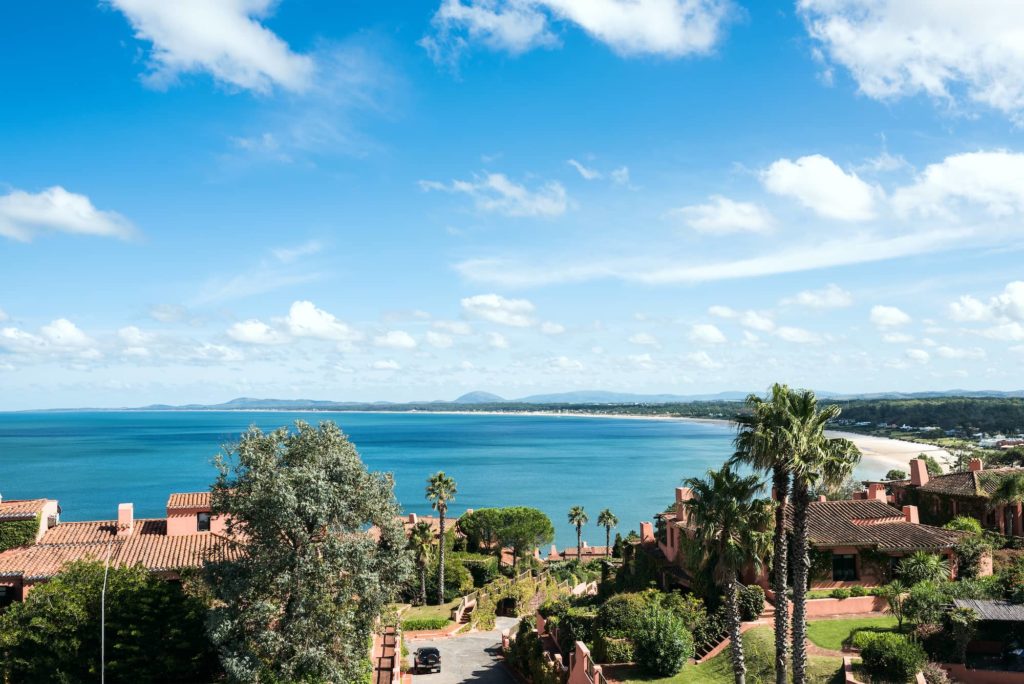
In a market where square footage and ocean views often dominate, a more rigorous standard is quietly reshaping coastal luxury: energy efficiency as a guiding design principle. For international buyers considering Uruguay’s coastline, the integration of passive house certification, cross-laminated timber (CLT) construction, and net-zero readiness is less an environmental gesture than a structural promise of durability, comfort, and long-term value. This article examines how these technical strategies might be reimagined for a site like José Ignacio, where understated performance defines the modern luxury ethos.
Table of Contents
Cross-Laminated Timber and the Passive House Envelope
At the heart of the passive house standard lies an exceptionally airtight and insulated building envelope. Research from documented case studies shows that airtightness levels as low as 0.28 air changes per hour (ACH) at 50 pascals are achievable with careful detailing—a figure far more stringent than conventional construction. CLT panels, fabricated in controlled factory environments, offer a natural advantage: their dimensional stability and minimal joints reduce thermal bridging and air leakage pathways.
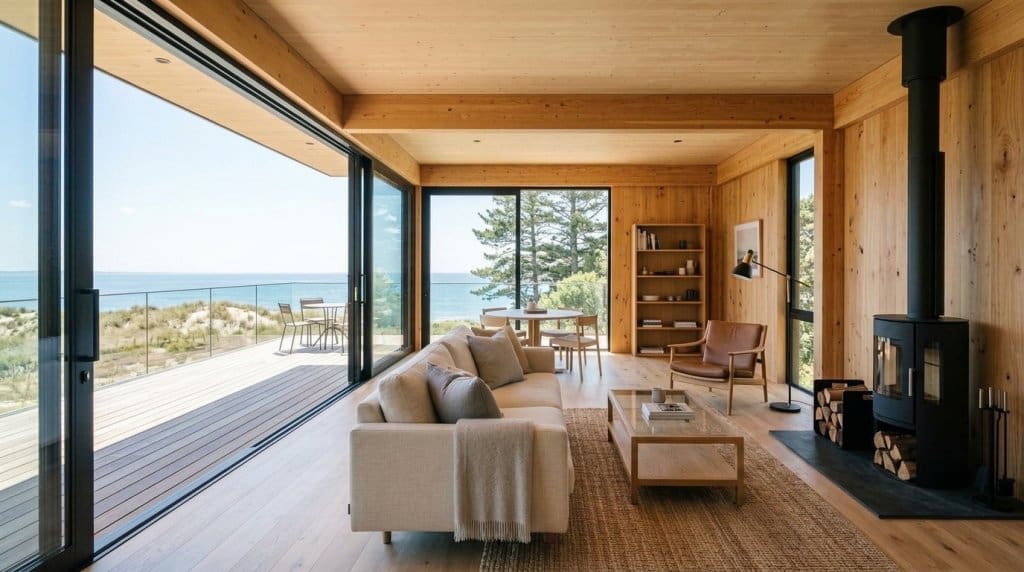
The roof structure, in particular, can be engineered for dual purpose. A CLT roof with deep cantilevers functions as a solar parasol, calibrated to block high summer sun while allowing low winter sun to penetrate—a passive solar strategy originally developed for heating-dominated climates but adaptable to Uruguay’s temperate coastal conditions.
Mechanical systems complement the envelope. In practice, CLT houses as this European firm produces rely on high-performance heat pumps for heating and cooling, while energy recovery ventilators (ERVs) maintain indoor air quality without wasting conditioned air. European-style triple-pane windows with U-values of 0.10 or lower further minimize heat transfer. The result is a home that requires minimal active energy to remain comfortable year-round.
Team Haverkate’s Perspective: Energy Efficiency as a Market Differentiator
From Team Haverkate‘s vantage point advising international buyers, energy-efficient construction is not merely a design choice—it is a strategic investment. In our experience, homes built to certified standards such as Passive House or net-zero ready command a measurable resale premium. A market analysis by New Hampshire Real Estate experts indicates that green-certified homes sell for 5–10 percent more and move 3–5 percent faster than conventional equivalents. While Uruguay lacks comparable localized benchmarks, the principle is transferable: as awareness grows, early adopters of energy-efficient design will hold an edge.
The upfront cost premium of 5–10 percent is offset by long-term operational savings. Studies have measured lifetime benefits of $3.66 for every dollar invested in energy efficiency through reduced utility bills, improved occupant health, and lower maintenance. For a coastal property in José Ignacio, where energy costs can spike with seasonal occupancy, net-zero or solar-ready systems offer both financial predictability and independence.
Additionally, CLT and engineered wood products store roughly one tonne of CO2 per cubic meter, making them a carbon-negative structural material. That dimension of sustainability increasingly resonates with discerning European and North American buyers who track embedded carbon alongside aesthetic value.
The Future of Coastal Architecture in Uruguay
Energy efficiency as a design principle is not a passing trend but a permanent shift in how fine architecture is conceived. For Uruguay’s coastal region, the combination of CLT construction, passive house standards, and net-zero readiness offers a template for homes that are as responsible as they are refined. The quiet intelligence of a building that breathes with its environment—rather than fighting it—is the essence of sober-luxury living.
Before committing to a property investment, international buyers should be aware of dual agency, a practice in which one agent represents both buyer and seller in a transaction. This arrangement creates an inherent conflict of interest that can lead to inflated valuations or undisclosed property liabilities. In Uruguay, where the market lacks the transparency of some jurisdictions, retaining an exclusive buyer’s representative is a critical step toward protecting your capital.
Team Haverkate has built its reputation on guiding international clients through Uruguay’s real estate landscape with objectivity and deep local knowledge. Our role is to identify properties that not only meet your lifestyle vision but also stand the test of time—structurally, economically, and environmentally. Whether you are drawn to the wild coastline of José Ignacio or the quiet countryside of Garzón, we help you navigate the market with clarity and confidence.
We maintain excellent, long-standing relationships with trusted local specialists in sustainable and CLT construction. Buyers interested in exploring this approach for a property in Uruguay are encouraged to reach out directly — we’re happy to make the right introduction.
Frequently Asked Questions
What is the Passive House standard and how does it apply to coastal homes?
The Passive House standard is a rigorous energy-efficiency certification focusing on an exceptionally airtight and insulated building envelope, high-performance windows, and mechanical ventilation with heat recovery. For coastal homes like those in José Ignacio, it ensures durability, comfort, and minimal energy use year-round, even in humid or windy conditions.
How does cross-laminated timber (CLT) improve energy efficiency in construction?
CLT panels are fabricated in controlled factory environments, offering dimensional stability and minimal joints that reduce thermal bridging and air leakage. This helps achieve Passive House airtightness levels as low as 0.28 ACH, while also storing roughly one tonne of CO2 per cubic meter, making it a carbon-negative structural material.
What are the benefits of net-zero ready or solar-ready systems for a coastal property in Uruguay?
Net-zero ready systems, such as high-performance heat pumps and energy recovery ventilators, provide financial predictability by minimizing utility bills and reducing reliance on the grid. They also offer independence during seasonal occupancy spikes and align with the values of discerning buyers who prioritize sustainability and long-term operational savings.
Do energy-efficient homes command a higher resale value in Uruguay?
While Uruguay lacks localized benchmarks, data from markets like the US shows that green-certified homes sell for 5–10 percent more and move 3–5 percent faster than conventional equivalents. As awareness grows, early adopters of energy-efficient design in Uruguay are likely to hold a competitive edge, with a 5–10 percent upfront cost offset by lifetime savings of $3.66 per dollar invested.
What is dual agency and why should international buyers be cautious?
Dual agency occurs when one agent represents both the buyer and seller in a transaction, creating an inherent conflict of interest. This can lead to inflated valuations or undisclosed property liabilities. In Uruguay’s less transparent market, retaining an exclusive buyer’s representative is critical to protect your capital and ensure objective guidance.
How does passive solar design work for Uruguay’s temperate coastal climate?
Passive solar design uses elements like deep roof cantilevers to block high summer sun while allowing low winter sun to penetrate, reducing heating and cooling loads. Adapted for Uruguay’s mild coastal conditions, this strategy minimizes active energy use and enhances thermal comfort without complex mechanical systems.