Key Takeaways
- Decree 238/026 caps cash at 200,000 UI, or 5% of transaction value when that stays below 450,000 UI — and splitting one legal transaction into multiple cash payments is explicitly prohibited.
- Non-compliance triggers a fine of 25% of the amount paid or received through non-admitted means, with a 1,000 UI minimum that rises to 10,000 UI for recidivism.
- The reform repeals the LUC’s fixed $160,000 dollar benchmark in favor of an inflation-indexed UI threshold, pushing Uruguay’s dollarized property market toward wire transfers, notarized payment plans, and documented sourcing.
Table of Contents
New Cash Payment Caps Redraw Uruguay’s Transaction Rules
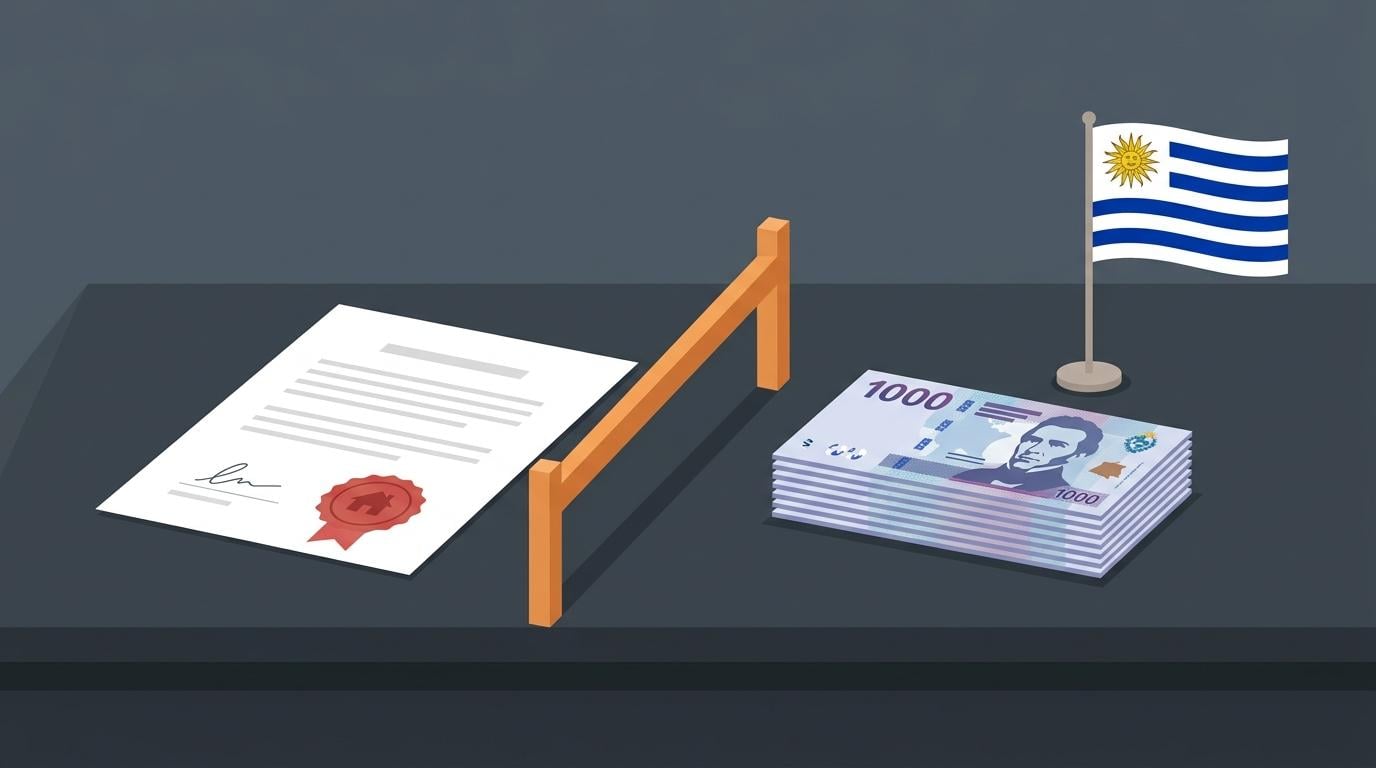
Cash payments in Uruguayan legal transactions must now stay within 200,000 Unidades Indexadas (UI) or 5% of the total operation value where that percentage remains below 450,000 UI, under Decree No. 238/026 dated October 1 and first reported by Ámbito Financiero. The Executive Branch regulation activates the cash-restriction regime embedded in the anti-money-laundering reform approved in March, replacing a previous statutory environment that had permitted far looser dollar-based thresholds. For international investors and property buyers, this is not a procedural footnote: it changes settlement mechanics, compliance exposure, and the evidentiary trail for Uruguayan real assets.
The new framework applies to purchase and sale agreements, loans, and other legal transactions regardless of the nature of the parties. Any remaining balance beyond the permitted cash portion must be settled through other payment instruments, and transactions may not be split into multiple cash payments to stay under the limit.
Inside Decree 238/026: Thresholds, Splitting Rules, and Penalty Mechanics
Decree No. 238/026 creates two operative thresholds. A payer may use cash up to 200,000 UI, or 5% of the transaction’s total value when that 5% does not exceed 450,000 UI. The structure means smaller deals face a flat ceiling, while larger operations receive a proportional allowance that maxes out well above the flat cap.
For clarity, the regulation produces the following mechanics:
- Primary ceiling: Cash payments are permitted up to 200,000 UI per legal transaction.
- Proportional alternative: A cash component of 5% of the transaction value is permitted so long as it does not exceed 450,000 UI.
- Splitting prohibition: A single legal transaction cannot be divided into multiple payments to evade the cap.
- Penalty base: Non-compliance triggers a fine of 25% of the amount paid or received through non-admitted means, with a minimum of 1,000 UI.
- Repeat conduct: Recidivism raises the minimum fine to 10,000 UI.
As reported by Ámbito Financiero, the previous framework traced back to the Financial Inclusion Law under José Mujica, which set a $6,000 cash ceiling, and then to the LUC under Luis Lacalle Pou, which raised that limit to $160,000. The 2022 referendum upheld the higher LUC threshold, but the March anti-money-laundering reform repealed the dollar benchmark in favor of the new UI-based mechanism.
This replacement matters operationally: parties can no longer rely on a fixed dollar number that remains predictable in nominal terms. The indexed threshold will move with Uruguay’s inflation-adjusted unit, creating an evolving compliance perimeter for lawyers, accountants, and real estate brokers.
For property closings, the splitting prohibition is especially relevant because deposits, installments, and final payments may be aggregated into a single legal transaction. Buyers and sellers who structure payments across multiple dates without documenting the underlying legal unity could inadvertently trigger penalty exposure.
Team Haverkate’s Read: AML Reform Meets Real Asset Execution
At Team Haverkate, we view the new cash cap as a transparency accelerator rather than a brake on real estate demand. The IMF’s 2022 Financial System Stability Assessment, hosted by the Banco Central del Uruguay, already identified real estate and construction among the sectors most vulnerable to illicit capital placement. Uruguay’s 2020 GAFILAT Mutual Evaluation rated the AML/CFT system as moderately effective, and the reform now closing that gap is aimed squarely at sectors where high-value assets and discretionary payment channels converge.
The political friction is real. The new framework cuts across a referendum result that had ratified the LUC’s higher $160,000 cash benchmark, and some opposition voices questioned whether the March reform respected that popular mandate. That tension does not change the compliance obligation, but it signals that cash restrictions in Uruguay remain politically sensitive, especially in a dollarized economy where approximately 80% of deposits are held in U.S. dollars.
For investors, the practical consequence is that real-estate purchases will increasingly require bankable settlement paths: wire transfers, notarized payment plans, and clearer sourcing documentation. This raises the value of local legal and compliance professionals who can structure transactions without triggering splitting concerns or penalty exposure.
Team Haverkate maintains excellent vetted local contacts for regulatory and legal structuring related to property transactions; investors considering cash-involved purchases should reach out directly for an introduction.
A Digital-Regulatory Frontier for Uruguay’s Next Investment Cycle
Uruguay is converging two forces: deep dollarization and increasingly formal financial surveillance. The new UI-based cash limit does not target foreign capital; it targets opacity. Buyers and sellers who adapt early will benefit from cleaner title histories, better counterparty verification, and a stronger institutional signal to international lenders and insurers.
That institutional signal matters well beyond this decree. The 2022 IMF assessment documented both high dollarization and low private credit penetration, while financial inclusion had improved to 74% of adults holding a bank account. Regulations that force more transaction volume through formal channels help deepen the local financial system and can eventually broaden credit markets that real estate investors rely upon.
Separately, international buyers should be wary of dual agency in Uruguay’s real estate market. Dual agency occurs when a single broker or firm represents buyer and seller in the same transaction, creating a conflict that can inflate valuations, obscure liabilities, and weaken the buyer’s negotiating position. Independent representation remains the cleanest safeguard against those risks.
Team Haverkate works as a committed guide for international buyers and investors navigating Uruguay’s shifting transaction landscape, helping clients convert new compliance requirements into stronger deal structures rather than obstacles.
Frequently Asked Questions
What is Uruguay’s new cash payment limit under Decree 238/026?
Cash payments in Uruguayan legal transactions are capped at 200,000 Unidades Indexadas (UI), or 5% of the total transaction value when that 5% does not exceed 450,000 UI. Any remaining balance must be settled through other payment instruments, such as bank transfers.
How does the 200,000 UI and 5% rule work for larger transactions?
Smaller deals face a flat 200,000 UI ceiling. Larger operations may use cash up to 5% of the total transaction value, but that proportional allowance cannot exceed 450,000 UI.
Can a buyer split a Uruguay property purchase into multiple cash payments to stay under the cap?
No. Decree 238/026 prohibits splitting a single legal transaction into multiple payments to evade the cap. Deposits, installments, and final payments may be aggregated into one legal transaction, so undocumented structuring can trigger penalties.
What are the penalties for exceeding Uruguay’s cash payment limit?
Non-compliance triggers a fine of 25% of the amount paid or received through non-admitted means, with a minimum of 1,000 UI. Repeat conduct raises the minimum fine to 10,000 UI.
Does the new cash restriction apply only to real estate transactions?
No. It applies to purchase and sale agreements, loans, and other legal transactions regardless of the nature of the parties. Real estate closings are a key focus because of high values and staged payment structures.
Why did Uruguay replace the $160,000 cash limit with a UI-based threshold?
The March anti-money-laundering reform repealed the dollar benchmark from the LUC era and introduced a UI-indexed mechanism. This means the compliance threshold moves with Uruguay’s inflation-adjusted unit rather than remaining fixed in nominal dollar terms.
What should international buyers do if they planned to use cash for a Uruguayan property purchase?
They should use bankable settlement paths such as wire transfers, notarized payment plans, and clear sourcing documentation. Working with local legal and compliance professionals can help avoid splitting concerns and penalty exposure.