Key Takeaways
- The diesel overcost above import parity reached $185 million last year, with $80 million of that channeled through the Sustainable Mobility Trust to keep urban bus fares below real operating cost.
- Agroindustrial chains consume roughly 40% of Uruguay’s diesel, so moving the subsidy to gasoline would relieve agricultural and freight margins while shifting fiscal weight onto households and passenger fleets.
- The design stakes are visible in the numbers: March 2025 fuel prices rose 7%, versus up to 35% for gasoline and 60% for diesel under full import-parity pass-through.
Table of Contents
An $80 Million Diesel Surcharge Quietly Underwrites Uruguay’s Buses
Uruguay’s productive sector now channels roughly $80 million a year into keeping urban bus fares below their real operating cost. The transmission is not a direct appropriation but a surcharge embedded in diesel prices. That mechanism may be about to change.
Economy and Finance Minister Gabriel Oddone confirmed the government is evaluating a shift of the urban bus ticket subsidy from diesel toward gasoline, a possibility first reported by Ámbito. As of October 2026, no final decision exists, and the proposal is being assessed alongside the Ministry of Industry, Energy and Mining and the Ministry of Transport and Public Works.
Oddone made the statement at the Economic Forum of the Christian Association of Business Leaders. He framed the review as part of a broader effort to make subsidy fixation more transparent.
Inside the Fuel-Price Mechanism Shifting Costs to Productive Sectors
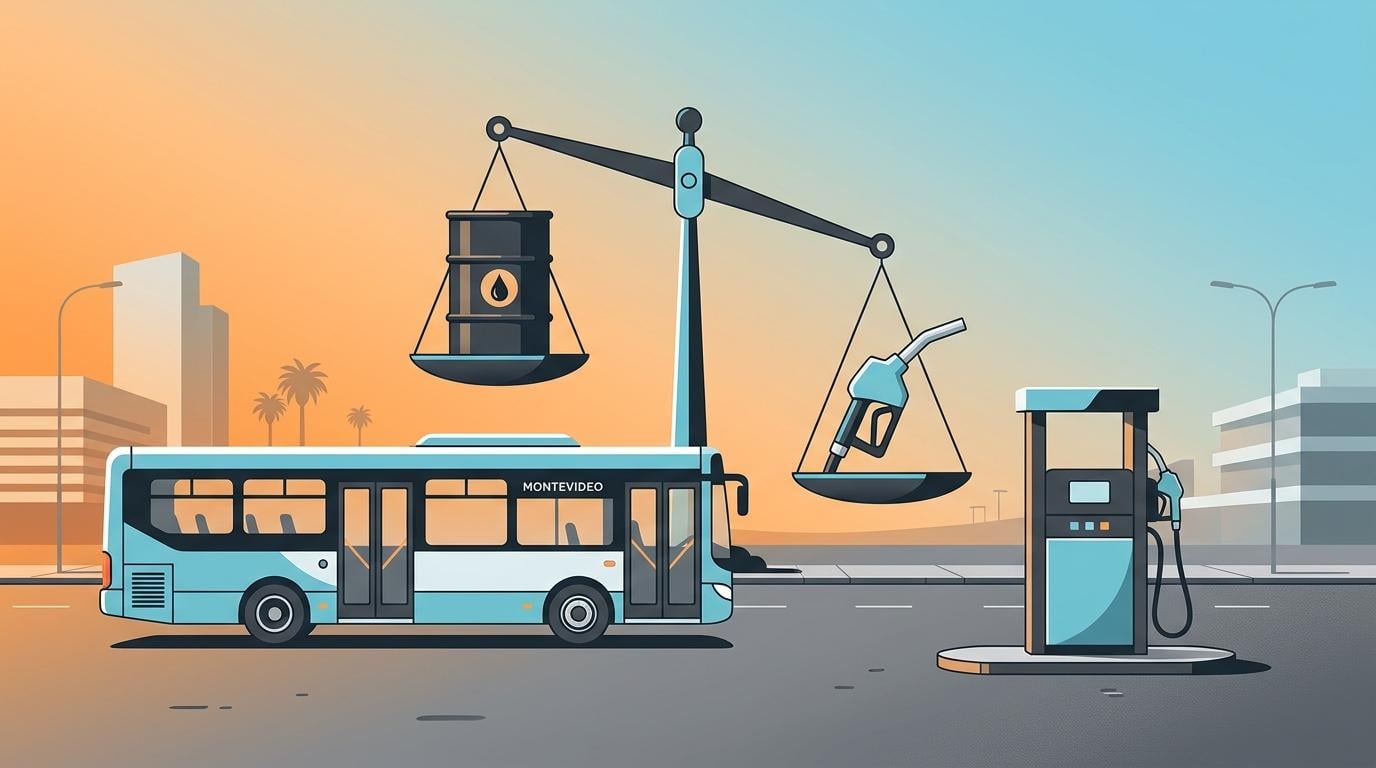
The current model works through the Sustainable Mobility Trust. Diesel sold to the public is priced above its import parity cost, and the excess is captured to cover the gap between what a bus passenger pays and the true cost of the trip.
In practice this is a cross-subsidy. Freight transport, agricultural producers, and industrial diesel buyers finance a portion of urban passenger mobility without receiving a direct service in return.
The Rural Federation has estimated that agroindustrial chains consume around 40% of diesel sold in Uruguay. The same organization calculated that the total diesel overcost above the import parity price reached $185 million in the last year, with the urban ticket component equal to the $80 million channel already noted.
A separate calculation from the Center for Public Policy Studies arrived at a similar conclusion by another route. Between March and December 2025, combined gasoline and diesel prices exceeded import parity by $88 million, with $50 million of the gap concentrated in diesel. That asymmetry is central to the political argument: diesel is disproportionately a production input, so the current subsidy design raises operational and logistics costs even as it keeps bus fares affordable.
- Agriculture and cargo transport: absorb the current diesel surcharge and argue that it erodes export competitiveness.
- Industrial operators: face higher fuel overheads linked to a subsidy that does not benefit their production chains.
- Urban transport users: remain shielded by the trust, but any shift to gasoline would transfer some fiscal weight to households and passenger fleets.
As Ámbito reported, Oddone described his own position as favorable in principle to making subsidy fixation more transparent, but he stressed that every transition carries costs and must be evaluated for timing. The debate arrives after a volatile fuel-pricing period: in March 2025, gasoline, diesel and liquefied petroleum gas prices rose 7%, while full pass-through of the import parity price would have implied increases of up to 35% for gasoline and 60% for diesel.
Private measurements still place Uruguayan gasoline and diesel among the highest in the region, which intensifies scrutiny of where the subsidy burden ultimately lands.
The Haverkate Read: Competitiveness Relief Meets Consumer Price Risk
Team Haverkate’s read is that this proposal is not a fiscal saving; it is a tax relocation. The total subsidy needed to close the urban transport gap does not disappear when the funding source moves from diesel to gasoline. What changes is the distributional footprint: agriculture, freight, and industrial operators would recover margin, while gasoline consumers and car-owning households would likely absorb more of the cost.
That creates genuine market tension. The policy is pro-competitiveness for export-oriented sectors, but it reintroduces a political risk because rising gasoline prices feed quickly into consumer sentiment and service-sector costs. Oddone’s caution appears calibrated to that risk, and the absence of a final decision signals that the government is weighing transition costs against a long-standing demand from the countryside and industry.
In client discussions, fuel costs are often treated as fixed inputs in Uruguayan asset underwriting. In fact, fuel taxation has become a quasi-fiscal instrument, meaning logistics-heavy property positions—from agricultural land to industrial parks—can shift materially with regulatory design.
Team Haverkate maintains excellent relationships with local fiscal and regulatory specialists who model fuel taxation, logistics exposure, and construction input costs; international investors assessing agricultural, industrial, or logistics-heavy property positions should reach out for a direct introduction.
Why Fuel Subsidy Design Now Matters for Uruguay’s Investment Case
Uruguay has built its investment narrative on institutional continuity, policy transparency, and respect for production. A debate over fuel subsidy design may look technical, but it cuts directly into that narrative. If the government proceeds with a transparent reallocation of the bus subsidy, it would demonstrate the capacity to rebalance fiscal burdens without abandoning social infrastructure.
The same logic extends to real assets. Construction materials, agricultural land values, and coastal property operating costs all carry indirect exposure to fuel policy. Investors who treat these as secondary variables often discover later that Uruguay’s regulatory choices shape operating margins as much as global commodity prices do.
Before committing capital to Uruguayan property, international buyers should also address a conflict-of-interest risk unrelated to fuel policy: dual agency. In this arrangement, the same broker represents seller and buyer in one transaction. The structure weakens negotiating leverage, can conceal material information, and may inflate valuations because the intermediary has an incentive to close at the highest price. Investors should insist on independent buyer-side representation from the first property tour.
For readers evaluating Uruguay as a destination for capital, the proposed fuel-subsidy shift is a reminder that the country’s market stability rests on fine-grained policy choices. Team Haverkate helps international buyers and investors interpret those choices—from fuel-adjacent input costs to full property due diligence—before capital is placed.
Frequently Asked Questions
What is Uruguay’s urban bus subsidy and how is it funded?
Uruguay’s urban bus fare subsidy is funded through the Sustainable Mobility Trust. Diesel is sold above its import parity cost, and the excess revenue covers the gap between what bus passengers pay and the true operating cost of urban transport. The mechanism channels roughly $80 million a year from diesel buyers to keep bus fares below their real cost.
Why is Uruguay considering shifting the bus subsidy from diesel to gasoline?
Economy and Finance Minister Gabriel Oddone confirmed the government is evaluating a shift of the urban bus ticket subsidy from diesel toward gasoline. The review aims to make subsidy fixation more transparent and reduce the burden on productive sectors, because diesel is disproportionately used as a production input by agriculture, freight, and industry. As of October 2026, no final decision exists, and the proposal is being assessed with the Ministry of Industry, Energy and Mining and the Ministry of Transport and Public Works.
Who currently pays the $80 million urban bus subsidy in Uruguay?
The subsidy is paid by diesel buyers, including freight transport, agricultural producers, and industrial operators. The Rural Federation estimated that agroindustrial chains consume around 40% of diesel sold in Uruguay, and that the total diesel overcost above import parity reached $185 million in the last year, with the urban ticket component equal to $80 million. A separate Center for Public Policy Studies calculation found that between March and December 2025, combined gasoline and diesel prices exceeded import parity by $88 million, with $50 million concentrated in diesel.
How would moving the subsidy to gasoline affect diesel users and households?
A shift from diesel to gasoline would likely let agriculture, freight, and industrial operators recover margin, while gasoline consumers and car-owning households absorb more of the cost. It would not eliminate the total subsidy needed to close the urban transport gap; it would relocate the tax burden. The change could also feed into consumer sentiment and service-sector costs because gasoline prices are highly visible.
Has Uruguay confirmed the change to its fuel subsidy design?
No. As of October 2026, there is no final decision. Minister Gabriel Oddone described his position as favorable in principle to making subsidy fixation more transparent, but stressed that every transition carries costs and must be evaluated for timing. The proposal remains under review with the Ministry of Industry, Energy and Mining and the Ministry of Transport and Public Works.
What does Uruguay’s fuel subsidy design mean for property investors?
Fuel taxation in Uruguay has become a quasi-fiscal instrument, so logistics-heavy property positions, agricultural land, industrial parks, and coastal properties carry indirect exposure through operating costs. Investors who treat fuel costs as fixed inputs may misprice assets because regulatory design can shape operating margins as much as global commodity prices do. International investors should model fuel taxation, logistics exposure, and construction input costs before committing capital.
What is dual agency and why does it matter for buying property in Uruguay?
Dual agency occurs when the same broker represents both seller and buyer in one transaction. The structure weakens negotiating leverage, can conceal material information, and may inflate valuations because the intermediary has an incentive to close at the highest price. Investors should insist on independent buyer-side representation from the first property tour.