Table of Contents
Dollar Resilience Amid Shrinking Tonnage Redefines Uruguay’s Meat Export Story
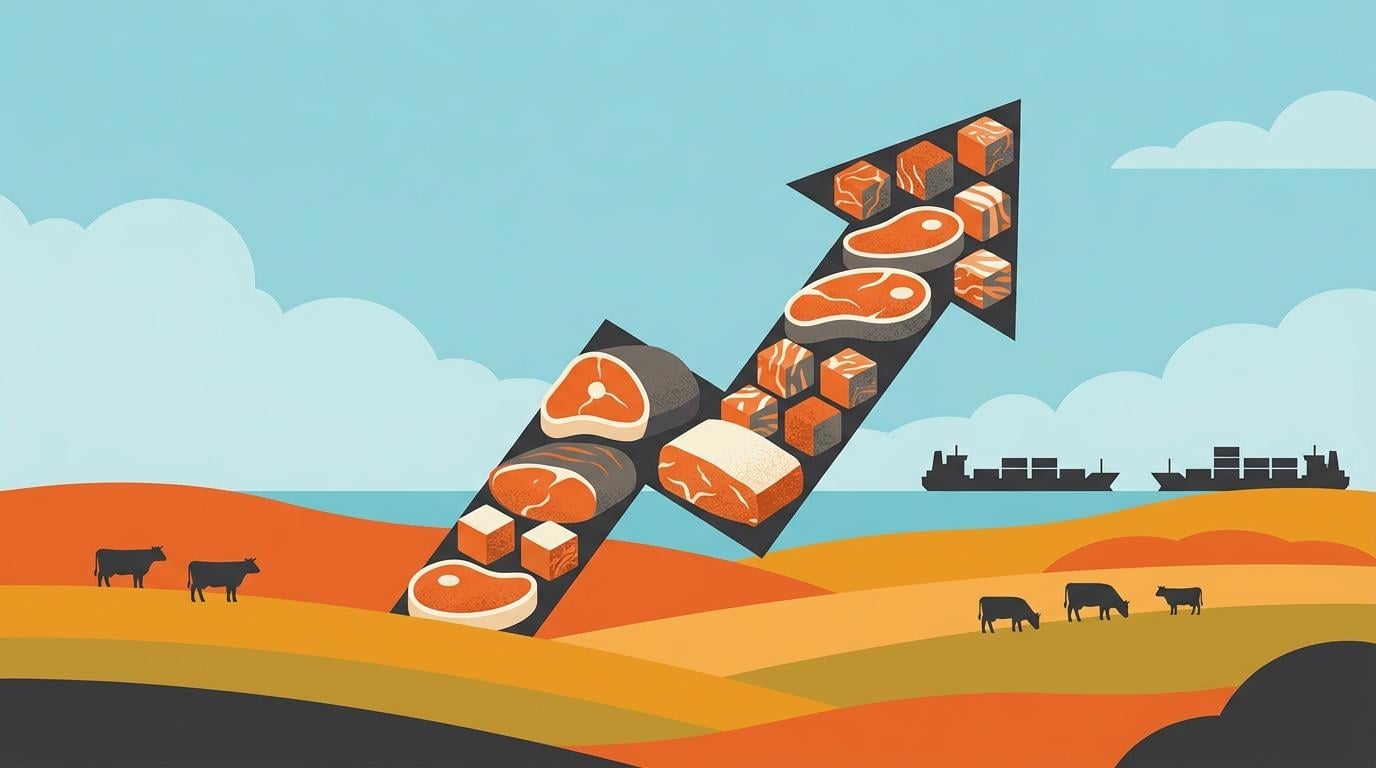
Uruguayan meat and meat-product exports reached $2,411.3 million between January 1 and September 26, a 2.7% increase over the same period in 2025, even as shipped volume contracted 8.87% to 460,543 metric tons.
The divergence came from a 12.69% improvement in the average export price, which climbed to $5,236 per metric ton. INAC data first reported by Ámbito show that higher unit values have more than offset lower tonnage, sustaining foreign-currency inflows in one of Uruguay’s most strategic export sectors.
For international capital watching Uruguay from the United States, Germany, Switzerland, or Austria, the signal is not simply about beef. It is about how a small economy monetizes scarcity while holding access to more than 100 markets.
The Price-Over-Volume Mechanism Behind the 2026 Numbers
Three destinations anchor the revenue base. Together they represent more than 80% of sector income.
- USMCA (United States, Mexico, Canada) — $787.5 million, 32.6% share
- China — $736.8 million, 30.5% share
- European Union — $424.3 million, 17.6% share
Beef remains the dominant engine, generating 84.36% of total sector foreign exchange. Shipments of bovine meat reached 254,379 metric tons worth $2,034.1 million, a 3.2% value increase over 2025, at an average price of $7,997 per metric ton.
Ovine meat moved in the opposite direction. Exports fell 14.3% in value to $38.5 million on 4,711 metric tons, although the average price of $8,187 per metric ton stayed above the beef figure.
Slaughter Declines Explain the Price Floor
Supply contraction is the mechanism behind these unit values. Through September 26, Uruguayan plants processed 1,508,220 cattle, 15.2% fewer than in 2025.
Ovine slaughter dropped even more sharply: 284,711 animals across 13 plants, a 35.4% year-on-year decline. Reduced processing tightens available export tonnage, supports prices, but also raises questions about plant utilization and rural labor demand.
The current cycle follows a record year. In 2025, total meat-sector exports reached $3,296.3 million, above the $3,210.7 million of 2022 and $3,046.8 million of 2021.
According to Ámbito, volume peaked differently: 2021 remains the decade’s high at 721,357 metric tons, while 2025 and 2024 shipped 704,009 and 689,192 metric tons respectively.
Team Haverkate’s Read: Why Supply Discipline Is an Asset-Class Signal
From Team Haverkate‘s perspective, the 2026 pattern is not a cyclical accident; it is a structural pricing signal with direct consequences for agricultural land, lease rates, and long-term capital deployment.
Uruguay’s beef export unit value continues to rank above its South American competitors. In September data from Meat & Livestock Australia, Uruguay averaged 10.0 AUD per kilogram in 2025 and 10.6 in 2026, compared with Brazil at 5.2 and 6.3, Argentina at 8.2 and 9.5, and Paraguay at 8.0 and 8.6. Australia and the United States still sit higher, but Uruguay’s re-rating relative to regional rivals is unmistakable.
The United States demand backdrop reinforces the case. USDA’s September livestock outlook cut 2026 beef production by 90 million pounds and noted a 19% year-on-year jump in July beef imports. Uruguay’s own US tariff-rate quota expanded from 13,000 metric tons in 2025 to 18,000 in 2026.
Competitive tension remains. Australia filled its China quota in late June, triggering diversion of Australian product into the United States and other premium markets. That could compress headroom at the top of the price distribution, even as Uruguay’s differentiated product positioning provides some insulation.
Livestock Minister Alfredo Fratti asserted in early October that Uruguayan cattle and beef are trading at historic prices, above Australia. That specific comparison has not been independently verified by a published price series, but the direction of travel is consistent with the broader value data.
For international capital evaluating exposure through farmland or agro-industrial assets, Team Haverkate maintains excellent vetted local contacts for agricultural property due diligence, rural legal structuring, and productive land acquisition.
From Abattoir to Land Registry: What This Means for Patient Capital
Uruguay’s meat-export complex is now demonstrating that currency resilience can coexist with lower volumes when the underlying asset base is differentiated. That distinction should shape how foreign investors underwrite rural property, agribusiness, and even coastal real estate exposure.
One risk that international buyers should address before any purchase is dual agency. This occurs when a single broker or firm represents both seller and buyer in the same transaction. The conflict is structural: one intermediary cannot simultaneously maximize the seller’s price and protect the buyer’s due-diligence leverage. In practice, dual agency can produce inflated valuations, obscure title or maintenance liabilities, and weaken negotiation. Investors entering Uruguay should insist on separate representation from the outset.
Meat-export data is not a real estate statistic, but it is a real-economy signal. Team Haverkate has long advised international buyers that Uruguay’s strongest locational assets are anchored by productive land, institutional supply chains, and policy continuity. As this export cycle shows, the country can defend value even when volumes retreat. For capital moving into Montevideo, Punta del Este, or rural Uruguay, that is a form of underlying collateral that few small economies can offer.
Frequently Asked Questions
How did Uruguay’s meat exports rise in value while volume fell in 2026?
Between January 1 and September 26 2026, Uruguayan meat and meat-product exports reached $2,411.3 million, a 2.7% increase year on year, while shipped volume fell 8.87% to 460,543 metric tons. The divergence came from a 12.69% rise in the average export price to $5,236 per metric ton, as tighter cattle and sheep slaughter reduced available tonnage and supported unit values.
Which markets account for most Uruguayan meat export revenue?
Three destinations anchor more than 80% of sector income: USMCA at $787.5 million and a 32.6% share, China at $736.8 million and 30.5%, and the European Union at $424.3 million and 17.6%. Beef remains the dominant engine, generating 84.36% of total sector foreign exchange, with bovine meat shipments of 254,379 metric tons worth $2,034.1 million at an average price of $7,997 per metric ton.
Why are Uruguayan beef prices higher than many South American competitors?
Supply discipline is a key mechanism. Through September 26, Uruguayan plants processed 1,508,220 cattle, 15.2% fewer than in 2025, while ovine slaughter fell 35.4% to 284,711 animals across 13 plants. Meat and Livestock Australia data show Uruguay averaged 10.0 AUD per kilogram in 2025 and 10.6 in 2026, compared with Brazil at 5.2 and 6.3, Argentina at 8.2 and 9.5, and Paraguay at 8.0 and 8.6. USDA also cut 2026 US beef production by 90 million pounds and reported a 19% year-on-year jump in July beef imports, while Uruguay’s US tariff-rate quota expanded from 13,000 to 18,000 metric tons.
What does Uruguay’s meat export data signal for agricultural land and rural property investors?
It signals real-economy resilience. A price-over-volume cycle can support farm income, lease rates, and productive land values when supply is tight. For patient capital, the data show Uruguay can defend foreign-currency inflows even as tonnage retreats, which helps anchor rural asset collateral, agribusiness underwriting, and long-term land acquisition strategies.
What are the main risks to Uruguay’s premium beef export position in 2026?
Australia filled its China quota in late June, triggering diversion of Australian product into the United States and other premium markets, which could compress headroom at the top of the price distribution. Livestock Minister Alfredo Fratti said in early October that Uruguayan cattle and beef are trading at historic prices above Australia, but that specific comparison has not been independently verified by a published price series. Lower slaughter also raises questions about plant utilization and rural labor demand.
How should international buyers avoid dual agency when purchasing property in Uruguay?
Insist on separate representation from the outset. Dual agency occurs when a single broker or firm represents both seller and buyer in the same transaction, creating a structural conflict because one intermediary cannot simultaneously maximize the seller’s price and protect the buyer’s due-diligence leverage. In practice, dual agency can produce inflated valuations, obscure title or maintenance liabilities, and weaken negotiation.
Does Uruguay’s meat export strength matter for Montevideo or Punta del Este real estate?
It matters indirectly. Meat-export data is not a real estate statistic, but it is a real-economy signal. Uruguay’s ability to defend value even when volumes retreat reinforces the country’s productive land base, institutional supply chains, and policy continuity. For capital moving into Montevideo, Punta del Este, or rural Uruguay, that underlying resilience can shape country-risk perception and collateral quality.