Key Takeaways
- Sound Money (8.62, 70th) and Freedom to Trade (8.06, 58th, up 0.09 year-over-year) anchor Uruguay’s 7.18 score — underpinning dollarized property transactions and cross-border fund repatriation for foreign buyers.
- Legal Systems and Property Rights posted the lowest absolute score at 6.08, yet ranks 50th globally — evidence of a workable title-security and contract-enforcement environment rather than a uniquely Uruguayan institutional flaw.
- The Fraser index deliberately excludes corruption metrics, so Uruguay’s 7.18 reflects pure economic policy outcomes: a capital-preservation profile built on stability, not a reform-driven appreciation story — making undisclosed dual agency a key diligence risk.
Table of Contents
A Regional Anchor Under Pressure
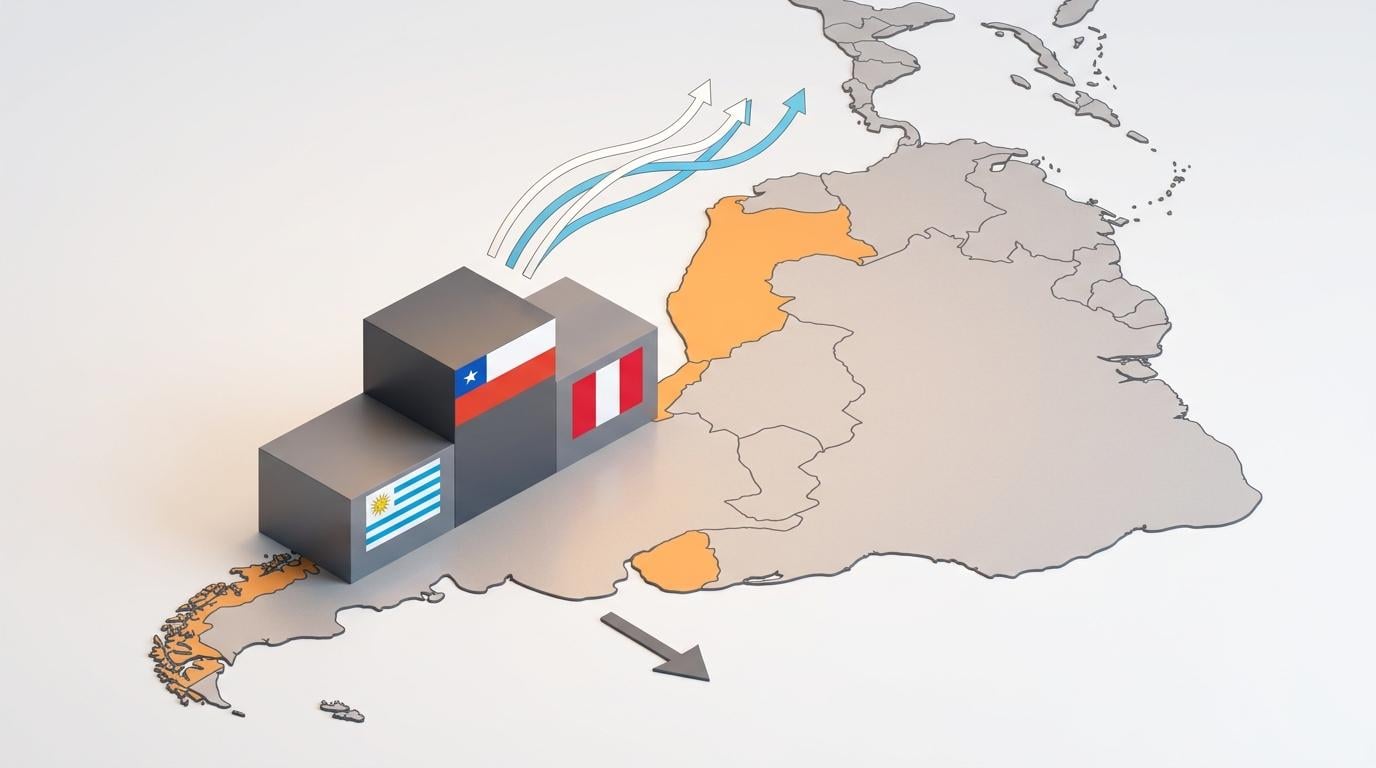
Uruguay’s economic freedom score reached 7.18 out of 10 in the Fraser Institute’s 2026 Economic Freedom of the World index, placing the country 59th among 165 jurisdictions and six positions lower than a year earlier despite a marginally stronger score. The slide, first reported by ámbito.com, did nothing to dislodge Uruguay from third place in South America, a regional standing it has defended behind Chile and Peru.
For international investors tracking institutional quality, the headline masks a more layered story. Uruguay’s score has oscillated between 7 and 7.5 for two decades, a pattern of structural stability that delivers predictability but limited upward momentum. The 2026 edition confirms that Uruguay remains a reliable regional anchor even as faster-moving economies widen the gap at the top of the global ranking.
Anatomy of the 7.18 Score
The index decomposes economic freedom into five areas: Size of Government, Legal Systems and Property Rights, Sound Money, Freedom to Trade Internationally, and Regulation. Uruguay’s performance across these categories is remarkably uneven, and the gaps explain why the country ranks third regionally but only 59th globally.
According to the Fraser Institute, Sound Money is Uruguay’s strongest pillar. Uruguay scored 8.62 in this category, driven by inflation reduction, controlled money growth, and open access to foreign-currency accounts. That translated to 70th place globally. Freedom to Trade Internationally followed at 8.06, with the 58th position reflecting low tariffs, minimal foreign-exchange black market activity, and financial openness. Notably, this category recorded the largest year-over-year improvement, gaining 0.09 points.
The other three pillars tell a less favorable story. Regulation produced a score of 6.58 and 75th place. Size of Government registered 6.56, the country’s weakest global ranking at 93rd and the category with the largest negative gap relative to regional leaders. Legal Systems and Property Rights delivered the lowest absolute score, 6.08, though its 50th global rank suggests this is a widespread institutional challenge rather than a uniquely Uruguayan weakness.
The 2026 edition draws on data through 2024, so these scores reflect economic conditions before the most recent policy cycle. For real estate investors, the composition matters. Property rights protection, while imperfect, ranks 50th globally — a reasonably safe environment for title security and contract enforcement. Sound Money at 8.62 underpins the dollarized real estate market and reduces currency risk for foreign buyers, while trade freedom supports cross-border repatriation of funds and international property transactions.
Team Haverkate’s Read: What the Ranking Signals for Property Investors
Team Haverkate has observed a recurring pattern among international buyers evaluating Uruguay: they arrive drawn by political stability and fiscal predictability, then ask whether the country’s institutional profile justifies committing capital at premium valuations. This index provides part of the answer.
The tension at the heart of Uruguay’s score is that its stability has become both its defining feature and its constraint. The Center for Development Studies, which co-publishes the index in Uruguay, frames the country as ‘relatively lagging’ in economic freedom despite two decades of consistent scoring. That assessment carries a hard implication: Uruguay is not an appreciation story built on institutional upgrades. It is a capital preservation story built on institutional reliability.
For real estate investors, the distinction shapes strategy. Prime Punta del Este, Montevideo‘s established residential corridors, and the emerging vineyard belt all price in stability rather than reform momentum. Buyers should underwrite accordingly — valuing the sound money score and property rights framework for the downside protection they deliver, not expecting a policy-driven re-rating to lift asset values.
One methodological nuance deserves attention: the Fraser index deliberately excludes corruption metrics, unlike other global freedom rankings. Uruguay’s 7.18 therefore reflects pure economic policy outcomes rather than governance perception, making its regional standing all the more credible as a signal for long-term capital deployment.
From Structural Stability to Investor Confidence
Uruguay’s third-place South American standing, even after a six-position global slide, reinforces the country’s value proposition for international capital: a jurisdiction where monetary policy and property rights remain dependable even if broad-based reform is slow. Chile and Peru may rank higher, but Uruguay’s unique blend of small-market liquidity, legal predictability, and currency stability continues to attract buyers from the United States, Germany, Switzerland, and Austria.
Investors acquiring Uruguayan real estate should remain vigilant about dual agency, where a single broker or firm represents both buyer and seller in the same transaction. This arrangement creates an inherent conflict of interest — the agent’s incentive to close at the highest possible price or fastest timeline can work against the buyer’s interest, leading to inflated valuations, under-disclosed liabilities, or compromised negotiation leverage. International acquirers unfamiliar with local market practices face elevated risk when dual agency is not explicitly disclosed and managed.
For those evaluating Uruguay’s investment landscape through the lens of this economic freedom data, the signal is equilibrium rather than acceleration. Team Haverkate helps international buyers and investors convert that stability into well-structured real estate positions, combining local market intelligence with rigorous institutional analysis to protect capital and align acquisitions with long-term residency or income goals.
Frequently Asked Questions
What is Uruguay’s economic freedom score in the Fraser Institute 2026 index?
Uruguay scored 7.18 out of 10 in the Fraser Institute’s 2026 Economic Freedom of the World index. That placed it 59th among 165 jurisdictions and third in South America, behind Chile and Peru.
Why did Uruguay fall in the global ranking despite a slightly higher score?
Uruguay’s score improved marginally, but other jurisdictions improved faster, pushing the country down six positions. The slide reflects relative rather than absolute decline, while Uruguay still ranks third in South America.
Which areas of economic freedom are Uruguay’s strongest?
Uruguay’s strongest pillars are Sound Money at 8.62 and Freedom to Trade Internationally at 8.06. Sound Money reflects inflation reduction, controlled money growth, and open foreign-currency accounts, while trade freedom gained 0.09 points year over year.
Which areas of economic freedom are Uruguay’s weakest?
Uruguay’s weakest areas are Legal Systems and Property Rights at 6.08, Regulation at 6.58, and Size of Government at 6.56. Size of Government has the weakest global rank at 93rd, while Legal Systems and Property Rights has the lowest absolute score.
What does Uruguay’s economic freedom score mean for real estate investors?
The score signals a capital preservation story rather than an appreciation story built on institutional upgrades. Sound Money supports the dollarized real estate market and reduces currency risk, while property rights protection ranks 50th globally, supporting title security and contract enforcement.
Is Uruguay a stable place to buy property compared with Chile and Peru?
Uruguay ranks third in South America behind Chile and Peru, but it remains a reliable regional anchor. Its score has oscillated between 7 and 7.5 for two decades, offering legal predictability and currency stability for long-term capital deployment.
What is dual agency in Uruguayan real estate and why is it a risk?
Dual agency occurs when one broker or firm represents both buyer and seller in the same transaction. This creates a conflict of interest that can lead to inflated valuations, under-disclosed liabilities, or weakened negotiation leverage, especially for international buyers unfamiliar with local market practices.