Key Takeaways
- The LACC MOVA logistics center adds 10,000 m² under a free-airport regime, enabling customs deferral and multimodal sea-road-air transfer for regional distribution.
- Team Haverkate views logistics density as a leading indicator for real asset demand, with Carrasco’s strategic location capturing South American trade flows.
- EU-Mercosur integration and infrastructure gaps (1.5% vs. 3.1% of GDP needed) underscore the potential for logistics real estate as a distinct asset class in Uruguay.
Table of Contents
A 10,000 m² Gateway Opens at Carrasco
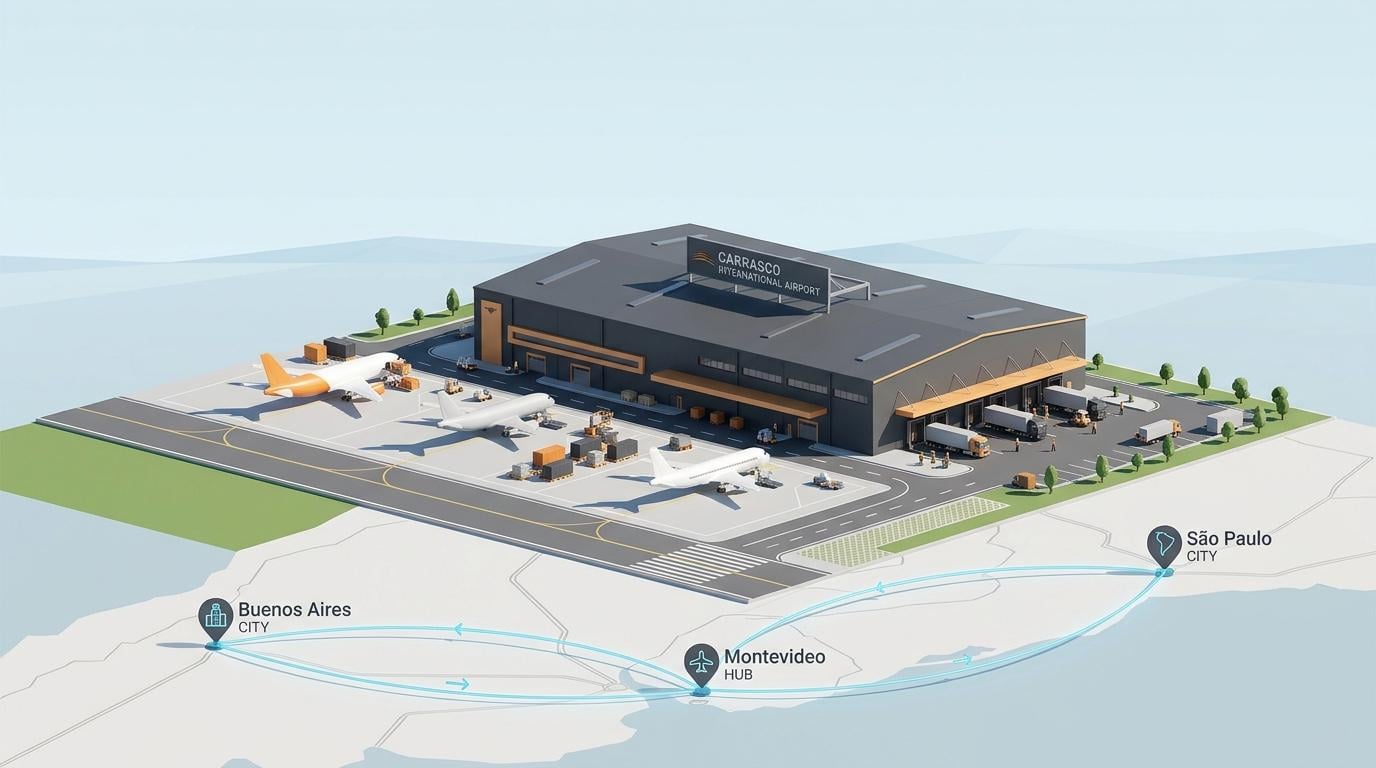
A USD 14 million logistics center opened at Carrasco International Airport on November 18, adding roughly 10,000 square meters of warehousing, e-commerce, and multimodal cargo capacity. The LACC MOVA platform, developed by Corporación América, is designed to receive goods from China by sea and move them onward by road or air across the Southern Cone.
The platform positions Montevideo as a 24-to-48-hour distribution point for Buenos Aires, São Paulo, and Santiago de Chile.
The addition pushes LACC’s built area to roughly 35,000 square meters, a clear signal that airport logistics is becoming a serious part of Uruguay’s trade infrastructure.
Why the Free-Airport Regime Changes the Math
MOVA operates under a free-airport regime. That status allows foreign goods to sit inside the airport perimeter under customs control without nationalization.
For an importer or investor, the advantage is deferral. Merchandise only enters Uruguay’s domestic customs territory if it is sold locally. Otherwise, it can be split, repacked, and re-exported without triggering import duties.
The target flow is sea-to-road-to-air. Containers arrive by ship from China, move to Carrasco, and then leave by road or air for regional buyers within one or two days.
Three features define the platform’s function:
- Customs deferral: foreign inventory can wait without nationalization.
- Multimodal transfer: sea entry, road connection, and air distribution meet in one node.
- Scale density: the airport operator’s logistics footprint expands materially.
Team Haverkate’s Read: Logistics Density as an Asset Signal
In our advisory work with international investors, we view logistics capacity as a leading indicator for real asset demand. A new free-airport platform of this type tends to pull warehousing, distribution, and service-sector property needs behind it.
The OECD’s Latin American Economic Outlook 2026 puts infrastructure investment across Latin America and the Caribbean at 1.5% of GDP in 2023. That compares with an estimated 3.1% of GDP needed annually through 2030.
Closing even half of the infrastructure gap with advanced economies could lift regional exports by up to 30%. Those figures are not Uruguay-specific, and they should not be read as a claim that one airport facility fixes the structural deficit. The gap remains wide.
Location is why this still matters. South America moves roughly 95% of its extraregional trade by sea, while road transport carries nearly half of trade with neighboring countries. Carrasco sits near the point where those flows overlap, giving a relatively compact asset outsized strategic value.
The EU-Mercosur interim trade agreement has been provisionally applied since 1 May 2026. Uruguay is projected to gain 0.61% in GDP from the deal, with bilateral trade rising about 37% under current alignment and potentially 70% with deeper regulatory convergence.
For an investor assessing Uruguay, the backdrop is clear: trade rules are opening, freight volumes are rising, and logistics real estate is becoming a distinct asset class.
What a Warehouse Says About Uruguay’s Next Decade
The Carrasco opening is not a story about airport cargo alone. It is a signal that Uruguay is building the physical infrastructure needed to capture regional trade flows as EU-Mercosur integration deepens and Asian supply chains look for efficient entry points into South America.
Still, logistics development and property investment carry different local risks. One risk on the buying side worth flagging is dual agency. This occurs when a single broker or firm represents both buyer and seller in the same transaction. The structure creates a conflict: the broker’s fee often depends on closing at the highest price, while the buyer needs someone checking for inflated valuations, hidden liabilities, and weak negotiation leverage. An investor should never accept a setup where the same professional claims to serve both sides.
For international buyers and investors evaluating Uruguay’s logistics-linked property and broader real estate market, Team Haverkate provides on-the-ground guidance. The firm helps clients assess real assets, avoid structural mistakes, and connect with vetted local legal and tax specialists when cross-border structuring is required.
Frequently Asked Questions
What is the LACC MOVA logistics center at Carrasco Airport?
The LACC MOVA platform is a USD 14 million logistics center that opened at Carrasco International Airport on November 18. Developed by Corporación América, it adds roughly 10,000 square meters of warehousing, e-commerce, and multimodal cargo capacity, bringing LACC’s total built area to about 35,000 square meters. It is designed to receive goods from China by sea and redistribute them by road or air across the Southern Cone within 24 to 48 hours.
How does the free-airport regime at Carrasco benefit importers and investors?
Under the free-airport regime, foreign goods can remain inside the airport perimeter under customs control without being nationalized. Importers only pay duties if merchandise enters Uruguay’s domestic customs territory for local sale. Otherwise, goods can be stored, split, repacked, and re-exported without triggering import duties, creating a significant customs deferral advantage.
Why is Montevideo positioned as a regional distribution hub for South America?
Carrasco Airport sits near the overlap of two major trade flows: roughly 95% of South America’s extraregional trade moves by sea, while road transport carries nearly half of trade with neighboring countries. This location allows Montevideo to serve as a 24-to-48-hour distribution point for Buenos Aires, São Paulo, and Santiago de Chile, giving a relatively compact logistics asset outsized strategic value.
What does the Carrasco logistics center signal for Uruguay’s real estate and investment market?
Logistics capacity is viewed as a leading indicator for real asset demand. A new free-airport platform tends to pull warehousing, distribution, and service-sector property needs behind it. Combined with EU-Mercosur integration and rising freight volumes, logistics real estate is becoming a distinct asset class in Uruguay, attracting international investor interest in logistics-linked property.
How does the EU-Mercosur trade agreement affect Uruguay’s economy and trade flows?
The EU-Mercosur interim trade agreement has been provisionally applied since 1 May 2026. Uruguay is projected to gain 0.61% in GDP from the deal, with bilateral trade rising about 37% under current alignment and potentially 70% with deeper regulatory convergence. This opening of trade rules is expected to increase freight volumes and demand for logistics infrastructure.
What is dual agency and why is it a risk when buying property in Uruguay?
Dual agency occurs when a single broker or firm represents both buyer and seller in the same transaction. This creates a conflict of interest because the broker’s fee often depends on closing at the highest price, while the buyer needs independent checks for inflated valuations, hidden liabilities, and weak negotiation leverage. Investors should never accept a setup where the same professional claims to serve both sides.
What is the infrastructure investment gap in Latin America and how does it relate to Uruguay?
The OECD’s Latin American Economic Outlook 2026 puts infrastructure investment across Latin America and the Caribbean at 1.5% of GDP in 2023, compared with an estimated 3.1% of GDP needed annually through 2030. Closing even half of the gap with advanced economies could lift regional exports by up to 30%. These figures are regional, not Uruguay-specific, and one airport facility does not fix the structural deficit, but they underscore the strategic value of logistics investments like Carrasco.