Key Takeaways
- Temu’s April 2024 launch drove a 170% year-over-year parcel surge, prompting a $10 million courier terminal at Carrasco Airport—Latin America’s only Free Airport regime.
- The terminal enables same-day air dispatch from duty-free inventory, positioning Uruguay as a regional fulfillment hub for e-commerce, pharma, and tech cargo.
- OECD data shows Latin America invests only 1.5% of GDP in infrastructure versus a 3.1% need, so investors should underwrite Uruguay’s platform while pricing regional execution risk.
Table of Contents
A $10 Million Terminal Answers a Parcel Surge
International parcel flows through Uruguay jumped 170% year over year in the second half of 2024, the direct result of Temu’s April 2024 launch in the local market. That single consumer shift has now produced more than $10 million in airport infrastructure: Latin America Cargo City’s new Courier Terminal at Carrasco International Airport in Montevideo.
Built on the footprint of the old passenger terminal, the facility is now operational in late 2026. The development was first reported by Latin Times. It marks the most ambitious air cargo investment in the country’s history and a direct answer to an e-commerce wave that arrived faster than the existing logistics could absorb.
Before Temu, Uruguay moved roughly 45,000 to 50,000 international parcels per month. LACC’s e-commerce segment was growing at a comfortable 15% annually. The Chinese platform did not just accelerate those projections; it made them obsolete.
Maximiliano Lema, LACC’s head of business development, put the volume shock plainly:
Sometimes it’s three times as much as we were expecting.
For international investors, the story is not only about parcels. It is about Uruguay converting a demand shock into a regulatory and logistics test: can a small South American market become a duty-free distribution point for the region?
Inside the Courier Terminal and Uruguay’s Free-Airport Edge
What the New Terminal Adds
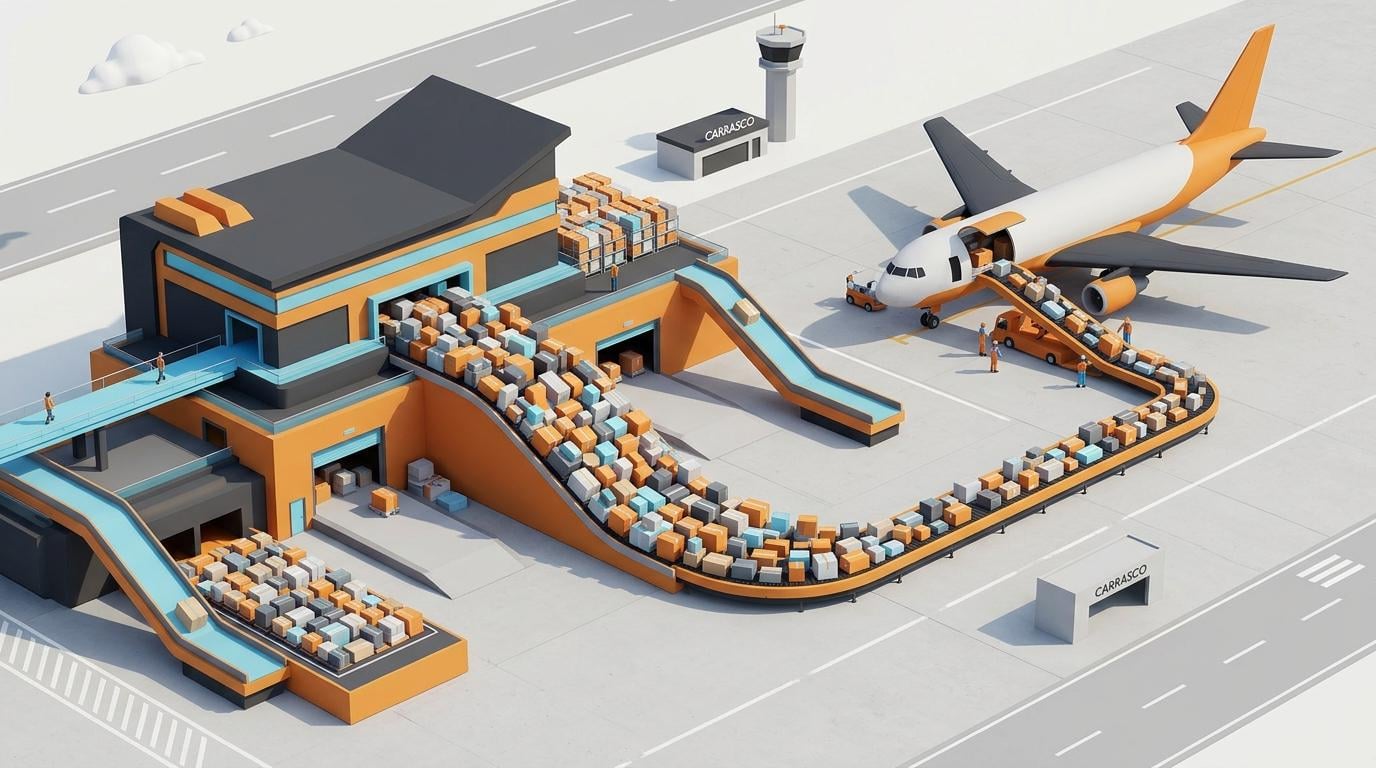
According to Latin Times, the capital outlay covers a 5,000-square-meter building with corporate offices and multipurpose logistics rooms. The design is tailored to rapid e-commerce growth rather than the slower rhythms of traditional air freight.
- Location: The footprint of the airport’s former passenger terminal.
- Facility: Corporate offices and multipurpose logistics rooms across 5,000 square meters.
- Legal base: Latin America’s only Free Airport regime.
More important than the square footage is the operational model it unlocks. A company can ship merchandise by sea to Uruguay, hold inventory under the free-airport regime, and once an online order arrives, dispatch the product by air the same day. That is just-in-time fulfillment aimed at Chinese platforms competing with Amazon’s domestic delivery speeds in Brazil and Argentina.
The Free-Airport Structure
Uruguay cannot compete on volume with São Paulo or Miami. Its population is about 3.5 million, and its domestic demand is small. The wager is different: speed, legal clarity, and a unique status.
Carrasco International Airport operates as Latin America’s only Free Airport. Goods can arrive by sea, be stored duty-free, and exit by air to any regional destination. Neither Buenos Aires nor São Paulo can replicate that combination under the same regulatory terms.
That legal distinction turns a small national market into a regional staging ground. LACC General Manager Bruno Guella has framed it as a continental ambition: consolidating Uruguay’s role as a regional hub.
Beyond E-Commerce: Pharma and Tech
Temu’s arrival expanded the range of products entering Uruguay through cross-border e-commerce: health items, electronics, and beauty products. Those categories overlap directly with pharmaceutical and technology supply chains.
Two major pharmaceutical multinationals, including GlaxoSmithKline, already run regional distribution operations from the airport. The same infrastructure that clears a consumer parcel can handle temperature-controlled vaccine shipments. LACC has also been exploring pilot programs to direct e-commerce flows toward Brazil.
The mixed-use design is therefore strategic rather than opportunistic. It positions the terminal to serve consumer logistics, medical logistics, and high-value tech cargo under the same free-airport framework.
Haverkate’s Read: Logistics Pressure Meets Real Economy
In our advisory work, we watch infrastructure investments like this because they rarely change the market alone. They do create second-order demand for commercial space, residential projects, and professional services near the airport and free-zone areas.
In our view, the terminal matters less as a stand-alone asset than as a signal about how Uruguay captures trade friction. The OECD’s 2026 Latin American Economic Outlook gives that signal a hard statistical backdrop: Latin America and the Caribbean should invest about 3.1% of GDP annually in infrastructure through 2030, but actual investment in 2023 was only 1.5% of GDP.
Air connectivity in Latin America still lags advanced economies, constraining high-value cargo flows. That is the tension behind this story. Uruguay has created a distinctive free-airport entrance for goods, but its regional advantage sits inside a broader infrastructure deficit that no single terminal can fix.
The OECD also estimates that narrowing half of the region’s infrastructure gap could lift exports by up to 30%. The opportunity is substantial, but so is the execution risk. Investors should underwrite the platform, not assume the region’s road and customs layer has already been solved.
The demand side is just as important. In an October 2026 interview with The Business Year, Martín Dovat, CEO of Zonamerica, pointed to post-pandemic supply chain disruptions and geopolitical bottlenecks as drivers of nearshoring and regional distribution demand in Uruguay. His figures for Zonamerica — more than 500 companies and over 7,000 direct jobs — are company-provided and have not been independently verified in that profile, but they align with the direction of travel we see on the ground.
Dovat also highlights Uruguay’s tax framework, capital-flow rules, quality of life, and proximity to Brazil, Argentina’s Vaca Muerta, Bolivia’s lithium, and Chilean and Peruvian mining. The airport terminal taps the same logic: companies want a stable, fast, low-friction point for moving goods across South American borders.
The EU-Mercosur interim trade agreement, provisionally applied since May 1, 2026, adds another layer. The OECD projects a 0.61% gain for Uruguay’s GDP over the implementation period. That is modest, but it points in the same direction as the airport investment.
From Parcel Hub to Permanent Capital
The parcel surge exposed a capacity gap, but the investment response turned that gap into a proof of concept for Uruguay’s regional hub claim. The new terminal is physical evidence that duty-free air distribution can work at Carrasco. The next question is whether logistics demand translates into broader demand for commercial real estate, residential projects near free-zone areas, and professional services tied to cross-border trade.
There is one risk on the buying side worth flagging. Would your agent represent both sides of the deal? In Uruguay, some international investors still encounter dual agency: one broker or firm standing on both sides of a purchase and collecting compensation from buyer and seller. That structure blunts price negotiation, can hide liabilities, and leaves the buyer without a genuinely independent advocate. For an offshore buyer following a headline like the airport terminal into a direct property move, the conflict can be expensive.
For investors following the cargo story into Montevideo, the operational logic is clear. Uruguay is building the physical and legal infrastructure to capture regional trade flows. Our team at Team Haverkate helps international buyers and investors turn macro signals into specific entry decisions — whether that means assessing free-zone-adjacent residential demand, reviewing commercial exposure to logistics assets, or coordinating with vetted local tax and legal specialists for cross-border structuring. The terminal is a story about parcels, but the longer-term test is whether incoming capital gets deployed with the same discipline.
Frequently Asked Questions
What is the new Courier Terminal at Carrasco International Airport?
The Courier Terminal is a $10 million, 5,000-square-meter facility built on the footprint of the old passenger terminal at Carrasco International Airport in Montevideo. Operated by Latin America Cargo City (LACC), it is designed for rapid e-commerce fulfillment and is now operational in late 2026. It is the most ambitious air cargo investment in Uruguay’s history.
Why did Uruguay build a new courier terminal?
International parcel flows through Uruguay jumped 170% year over year in the second half of 2024 after Temu launched locally in April 2024. Before that, Uruguay handled roughly 45,000 to 50,000 international parcels per month, and LACC’s e-commerce segment was growing about 15% annually. The surge overwhelmed existing logistics capacity, prompting the $10 million investment.
What is Uruguay’s Free Airport regime and why does it matter?
Carrasco International Airport operates as Latin America’s only Free Airport. Goods can arrive by sea, be stored duty-free, and exit by air to any regional destination. This lets companies hold inventory in Uruguay and dispatch orders same-day by air, creating a just-in-time fulfillment model that neither Buenos Aires nor São Paulo can replicate under the same regulatory terms.
Does the terminal serve industries beyond e-commerce?
Yes. Temu’s arrival expanded cross-border e-commerce categories such as health items, electronics, and beauty products, which overlap with pharmaceutical and technology supply chains. Two major pharmaceutical multinationals, including GlaxoSmithKline, already run regional distribution from the airport, and the same infrastructure can handle temperature-controlled vaccine shipments. LACC has also explored pilot programs directing e-commerce flows toward Brazil.
How does the terminal fit into Latin America’s infrastructure gap?
The OECD’s 2026 Latin American Economic Outlook estimates the region should invest about 3.1% of GDP annually in infrastructure through 2030, but actual investment in 2023 was only 1.5% of GDP. The OECD also projects that closing half the region’s infrastructure gap could lift exports by up to 30%. Uruguay’s free-airport advantage sits inside this broader deficit, so investors should underwrite the platform without assuming regional road and customs bottlenecks are solved.
What does the terminal mean for real estate and investment in Montevideo?
Infrastructure investments like this rarely change a market alone, but they create second-order demand for commercial space, residential projects, and professional services near the airport and free-zone areas. The terminal is physical evidence that duty-free air distribution works at Carrasco. The next test is whether logistics demand translates into broader demand for real estate and cross-border trade services.
What risks should international buyers watch when investing in Uruguay property?
One risk on the buying side is dual agency, where a single broker or firm represents both buyer and seller and collects compensation from both. That structure blunts price negotiation, can hide liabilities, and leaves the buyer without a genuinely independent advocate. Offshore buyers following macro signals like the airport terminal into a direct property purchase should secure independent representation and coordinate with vetted local tax and legal specialists.