KEY POINTS
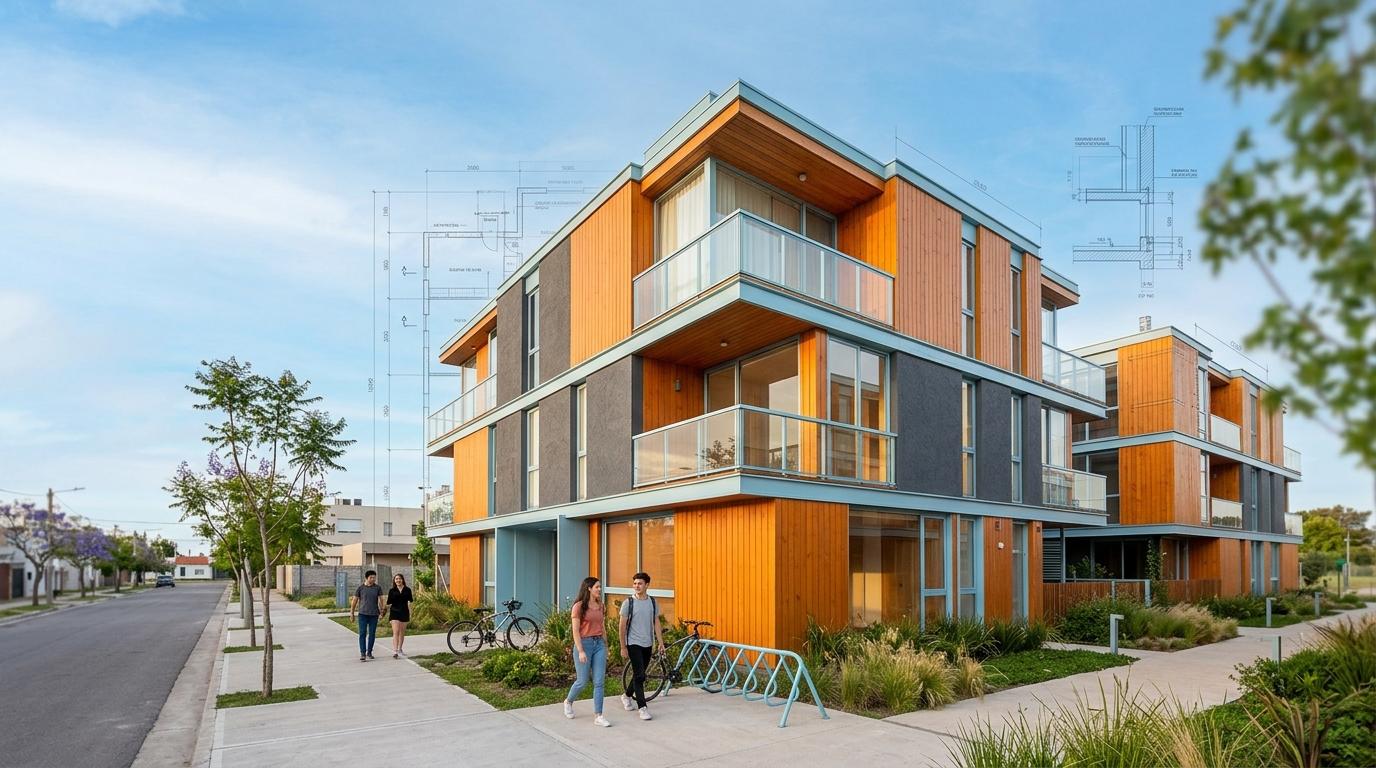
- Uruguay has built more than 1,000 wooden public housing units since 2011, with a new 64-home timber project in Rivera.
- All non-traditional construction methods must meet ministry technical approval for habitability, safety and durability.
- The public housing pipeline includes 26 buildings by 2030 valued at USD 115 million, plus over 3,000 completed cooperative homes and 5,800 in progress.
Uruguay’s public housing authority is scaling up wood construction and other non-traditional building systems to cut delivery times and budgets without weakening livability, safety, or durability standards.
The approach was outlined by Housing Minister Tamara Paseyro at a working lunch hosted by the Marketing Executives Association (ADM), with coverage by El Observador.
A development in Tranqueras, Rivera, delivered 64 wood-framed homes through MEVIR, part of a broader public housing experiment with multiple construction techniques. Since the first timber social housing project in Mandubí in 2011, Uruguay has built more than 1,000 wooden units through its public system.
Paseyro insisted that innovation cannot erode standards. All housing proposals must meet requirements for habitability, safety and durability, and non-traditional systems need technical approval from the ministry before use in public programs.
In 2025, the government reactivated the Honorary Commission for Wood and is now working with the Ministry of Transport and Public Works on a general construction framework for domestic timber. The aim is to create common technical criteria that guarantee quality and widen adoption.
Wood construction also represents a productive opportunity. Uruguay has more than one million hectares of planted forest, about 30 percent of which is used for solid wood, supported by a developed forestry supply chain. Using more timber in buildings can add value domestically, create jobs, and shorten on-site construction times.
Innovation extends beyond materials. Paseyro argued that public housing projects should respond to current living patterns and be judged on architectural quality, functionality and long-term adaptability—not only on cost per unit or total units delivered.
The state will keep its role as regulator and standard-setter, but Paseyro called on private companies to contribute technical capacity, knowledge and innovation.
Looking at the investment pipeline, the ministry projects 26 public housing buildings by 2030, involving roughly USD 115 million. Before families receive keys, each project mobilizes contractors, material suppliers, transport, professional services and workers across multiple regions.
Cooperative housing remains central. Since the current administration began through June 2026, more than 3,000 cooperative homes were completed and 5,800 remain under construction. The cooperative program absorbs over 50 percent of the Ministry of Housing’s resources.
The promoted housing regime has mobilized more than USD 5.17 billion and 32,500 homes since 2011. In 2025, 326 projects representing 15,281 homes entered the system, a 32 percent increase in project count from 2024. Sixty percent of new projects had up to 20 homes, and Montevideo’s share fell from a historical 65 percent to roughly half.
Paseyro also reframed territorial planning as more than mapping and permits. It means anticipating urban growth and locating housing near jobs, transport, education and services. She stressed that what is built matters as much as where it is built, noting that Ciudad Vieja has lost more than 60 percent of its population over five decades while infrastructure remains underused.
To address this, the ministry launched an Urban Economy, Circular Economy and Territorial Management Laboratory, starting in Minas and Paso de los Toros. The pilot aims to recover vacant properties and build land banks that give housing policy access to well-located soil when needed.
Strategic Implications for Real Estate and Investment
For international investors and expats, these moves signal a state-backed effort to modernize construction without compromising regulatory standards. The USD 115 million public building pipeline, a stable cooperative housing program, and a record number of promoted housing projects create predictable demand for land, materials and professional services outside Montevideo. Meanwhile, renewed focus on urban infill in areas like Ciudad Vieja may gradually improve valuations in consolidated districts, while timber certification frameworks reduce risk for developers exploring wood-based construction.